
Breathing is defined as an active physiological mechanism that directly modulates brain structure and cognitive function in aging adults. The process goes far beyond oxygen delivery. Each breath cycle influences neural oscillations in the limbic and cortical regions that govern memory, attention, and executive control. Understanding how breathing supports cognitive aging gives you a practical tool that requires no equipment, no prescription, and no special training. Techniques like paced breathing and respiratory phase alignment have now been linked to measurable structural brain changes and faster cognitive task performance in adults over 50.
How does breathing support cognitive aging through brain structure?
Paced breathing produces physical changes in the brain. A study of 55 adults aged 50–70 found that daily paced breathing over 9 weeks increased the volume of the left orbitofrontal cortex. That region is a hub for executive function, working memory, and decision-making. Larger volume in that area correlated directly with better performance on working memory and associative memory tasks.
The mechanism behind this change is neurovisceral integration. When you breathe at a steady, controlled pace, your heart rate oscillates in sync with your breath. That oscillation generates a signal that travels from the body to the brain, stimulating the orbitofrontal cortex and reinforcing its structural integrity. The key driver is not how many breaths per minute you take. Heart rate oscillatory power during paced breathing predicts orbitofrontal volume increases more reliably than strict adherence to a specific breathing frequency. This means the quality of your cardiac-respiratory coupling matters more than hitting an exact number.

Breathing also acts as a transdiagnostic biomarker for cognitive health, meaning its effects extend across multiple cognitive domains rather than targeting just one. For aging adults, this broad reach makes it especially valuable.
Pro Tip: Consistency in your breathing practice matters more than rigid frequency. Showing up daily for even 10 minutes of paced breathing builds more structural benefit than occasional long sessions.
Does respiratory phase alignment improve cognitive task performance?
The timing of your breath within a single cycle affects how well your brain encodes and retrieves information. Research on 30 volunteers showed that encoding and retrieving during late exhalation produced faster reaction times on memory tasks compared to other phases. The exhalation phase appears to create a brief window of heightened neural readiness.
This concept is called respiratory phase alignment. Your breath cycle functions as an internal context signal. When the phase of your breath matches the phase of a cognitive demand, your brain processes information more efficiently. Think of it as your nervous system using the rhythm of your breath as a timing cue to prepare for incoming information.
The table below shows how reaction time and processing efficiency vary across respiratory phases in memory tasks.
| Respiratory phase | Effect on memory encoding | Effect on reaction time |
|---|---|---|
| Early inhalation | Moderate neural activation | Slower |
| Late inhalation | Moderate activation | Moderate |
| Early exhalation | Increasing readiness | Moderate |
| Late exhalation | Peak neural readiness | Fastest |
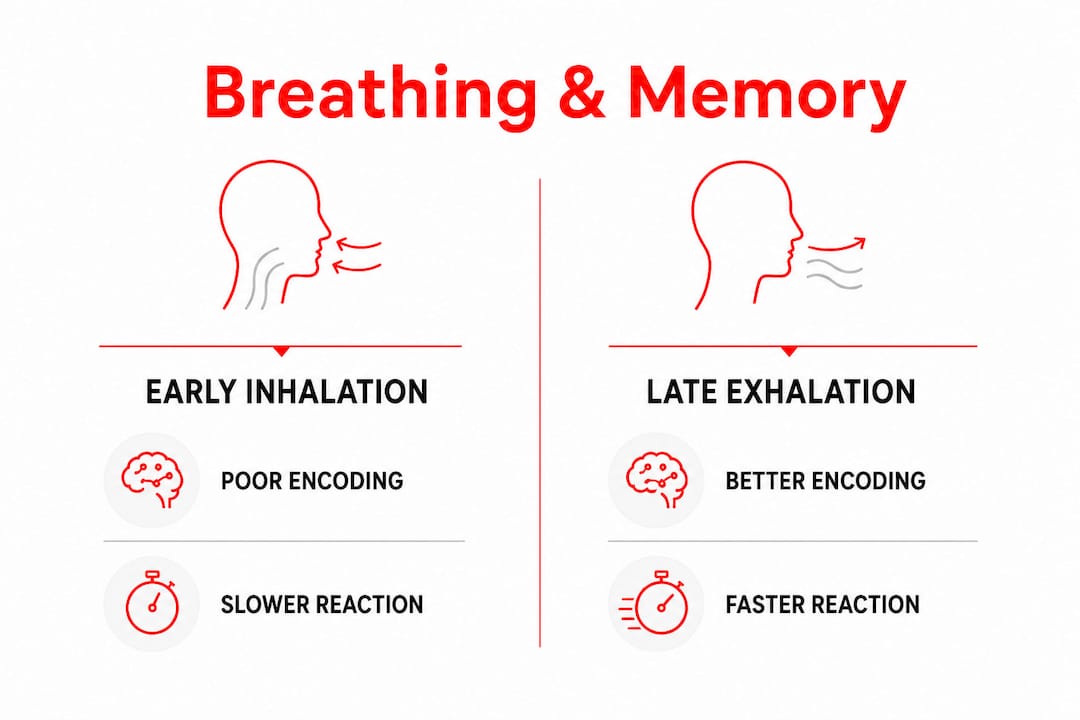
The practical implication is direct. When you are studying, recalling a name, or working through a complex problem, try to time your mental effort to the end of your exhale. This respiratory timing technique is a neurophysiological tool you already carry with you. The cognitive performance oxygen link between breath timing and brain efficiency is one of the more underappreciated findings in cognitive neuroscience.
Are all slow-paced breathing techniques equally beneficial for cognitive aging?
Slow-paced breathing is not a single, uniform intervention. A comparison of younger adults (n=82) and older adults (n=84) breathing at 6 versus 12 breaths per minute found that slow breathing enhances heart rate variability in both age groups. However, memory discrimination improved significantly only in younger adults. Older adults maintained stable cognitive performance across both breathing speeds.
This finding reframes the conversation about breathing techniques for cognition in older adults. Stability is a meaningful outcome. Maintaining cognitive performance as you age, rather than declining, represents a genuine protective effect. Slow-paced breathing appears to preserve that stability even when it does not produce the same sharp gains seen in younger people.
The emotional regulation effects also differ by age. Slower breathing reduces emotional intensity and false memories in younger adults, but older adults show comparable cognitive outcomes regardless of breathing speed. This suggests that older adults may already have more stable emotional baselines, or that their cognitive systems respond differently to autonomic input.
Mindfulness breathing and aging research points toward a practical takeaway: the right technique depends on your current state, not a universal protocol. When you feel mentally sluggish, a slightly faster, more activating breathing pattern may sharpen focus. When you feel anxious or stressed, a slower, longer-exhale pattern calms the nervous system and protects memory accuracy.
Pro Tip: Match your breathing technique to your current emotional or physical state. Use a slower 6-breath-per-minute pattern when stressed, and a slightly faster rhythm when you need to activate focus from a low-arousal state.
What neural mechanisms link breathing rhythms to cognitive processes?
Breathing does not just supply oxygen. Each breath cycle directly shapes the electrical activity of your brain. Invasive brain recordings reveal that respiration waveforms couple cycle-by-cycle with neural oscillations in limbic and cortical regions. That coupling influences how excitable your neurons are at any given moment, which in turn affects perception, attention, and memory.
The concept of active sensing explains why this matters. When you voluntarily align breathing to task demands, you coordinate your internal physiological state with external cognitive requirements. Your brain uses the breath rhythm as a scaffold for organizing sensory input and cognitive output. This is not a passive process. You can deliberately use your breath to prepare your brain for a demanding task.
The brain regions and functions most directly modulated by breathing rhythms include:
- Hippocampus: Memory consolidation and spatial navigation, both of which show phase-dependent modulation with breath cycles
- Amygdala: Emotional processing and threat detection, regulated partly through respiratory input to the limbic system
- Prefrontal cortex: Executive function, working memory, and attention, all of which benefit from the oscillatory coupling driven by paced breathing
- Olfactory cortex: A direct anatomical entry point for respiratory signals into the brain, linking breath to memory and emotion
- Orbitofrontal cortex: Decision-making and cognitive control, structurally responsive to sustained paced breathing practice
Understanding the impact of breathing on brain health at this level makes it clear that respiratory function and cognitive function are not separate systems. They are tightly coupled, and you can use that coupling intentionally.
Key Takeaways
Consistent, paced breathing is the single most accessible tool for supporting brain structure and cognitive function as you age.
| Point | Details |
|---|---|
| Brain structure responds to breathing | Nine weeks of paced breathing increases left orbitofrontal cortex volume in adults aged 50–70. |
| Breath timing sharpens memory | Encoding and retrieving information during late exhalation produces the fastest reaction times. |
| Older adults benefit from stability | Slow-paced breathing maintains cognitive performance in older adults even when memory discrimination gains are smaller. |
| Heart rate coupling drives the effect | Cardiac-respiratory oscillatory power predicts brain changes more than strict breathing frequency. |
| Breathing modulates multiple brain regions | The hippocampus, amygdala, prefrontal cortex, and orbitofrontal cortex all respond to breath cycle rhythms. |
Breathing and cognitive health: what the science actually tells us
The research on breathing and cognitive aging is more specific than most people realize. This is not about relaxation or stress relief in a vague sense. The studies point to measurable structural changes in the brain, phase-specific effects on reaction time, and age-differentiated outcomes that require you to think carefully about which technique you use and when.
What I find most compelling is the orbitofrontal cortex finding. That region sits at the intersection of emotion, memory, and executive control. The fact that a daily breathing practice can increase its volume in adults over 50 is not a minor footnote. It suggests that the brain retains more plasticity in response to respiratory input than most people assume.
The respiratory phase alignment data is equally striking. Most cognitive training programs focus on what you practice. This research suggests that when you breathe during a task matters just as much. Timing your mental effort to late exhalation is a zero-cost adjustment that can sharpen focus and speed up recall.
My honest caution is this: do not build a rigid protocol and follow it regardless of how you feel. The age-differential data on slow breathing shows that the same technique produces different outcomes depending on your baseline state. A 65-year-old who is already calm and focused may not need a 6-breath-per-minute protocol. Someone who is anxious before a cognitive task will benefit from it enormously. The science supports flexibility, not uniformity.
Moderate, consistent practice is the sustainable path. Ten minutes of paced breathing daily, with attention to your current state, will serve you better than an elaborate protocol you abandon after two weeks.
— Paul
Revo2 and the oxygen side of cognitive clarity
Breathing technique is one side of the equation. Oxygen quality is the other. When your respiratory function is already under strain from altitude, fatigue, or stress, even well-timed breathing delivers less to the brain.

Revo2 delivers 98% pure canned oxygen through a zero-leak mouthpiece, giving your brain a direct, efficient oxygen boost without the bulk of traditional medical systems. The design is portable and straightforward to use, making it practical for daily life, travel, or high-demand cognitive moments. Revo2 also provides clear guidance on how to use canned oxygen safely and effectively, so you get the benefit without guesswork. For anyone working to protect mental clarity as they age, pairing good breathing habits with reliable oxygen support is a practical and well-grounded approach.
FAQ
What brain region does paced breathing most directly affect?
Paced breathing most directly increases the volume of the left orbitofrontal cortex, a region central to working memory, executive function, and decision-making. This structural change has been documented in adults aged 50–70 after 9 weeks of daily practice.
When is the best time in a breath cycle to focus or memorize?
The late exhalation phase produces the fastest reaction times and best memory encoding efficiency. Timing your mental effort to the end of your exhale gives your brain its highest window of neural readiness.
Does slow breathing help older adults the same way it helps younger adults?
Slow-paced breathing maintains stable cognitive performance in older adults but improves memory discrimination more sharply in younger adults. The protective effect of stability is still a meaningful cognitive benefit for aging individuals.
How does breathing affect the brain beyond oxygen supply?
Each breath cycle couples with neural oscillations in the hippocampus, amygdala, and prefrontal cortex, directly modulating neural excitability and cognitive processing. This coupling means breathing actively shapes how your brain handles attention, memory, and perception.
How much daily breathing practice is needed to see cognitive benefits?
A 9-week study using daily paced breathing sessions produced measurable structural brain changes and cognitive improvements. Consistency over time, rather than session length or exact frequency, appears to be the primary driver of benefit.