
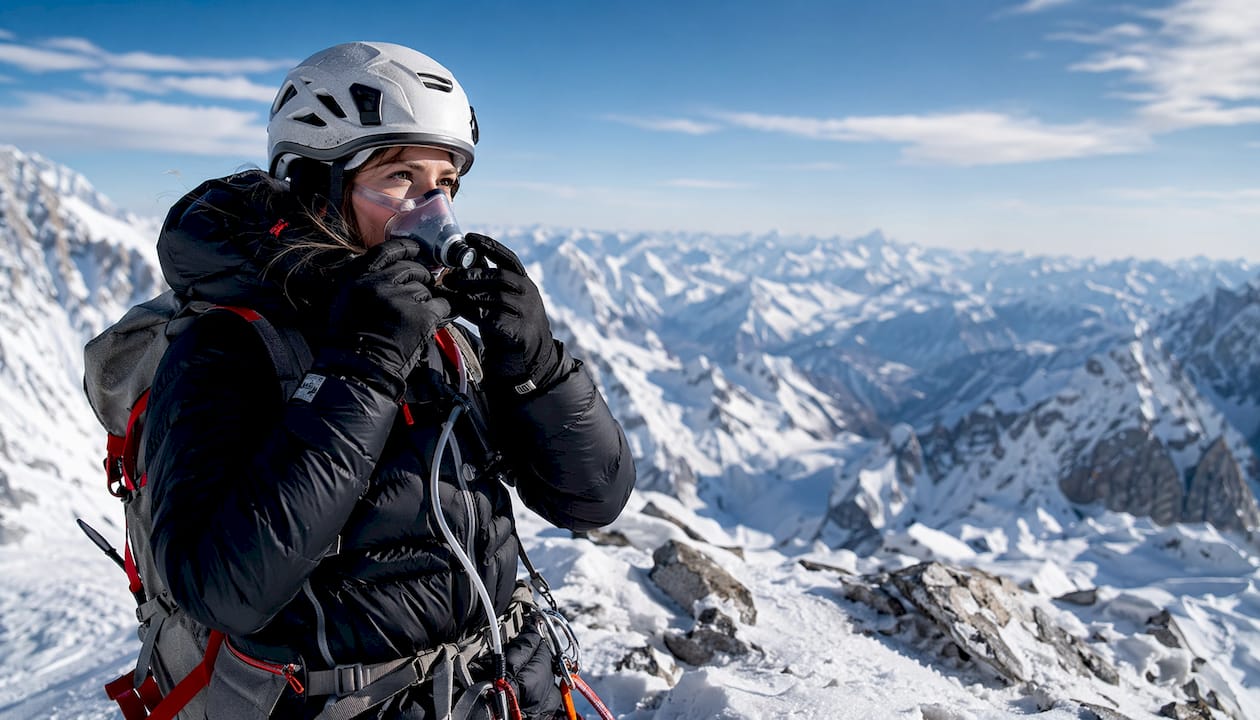
Supplemental oxygen is defined as breathing gas delivered above ambient atmospheric levels to counter the life-threatening effects of hypoxemia at extreme altitude. Climbers who choose to use supplemental oxygen on summit attempts gain a measurable physiological edge: 51% of fatalities on Everest’s Nepal side involved no oxygen use, a figure that makes the safety case plainly. Beyond survival statistics, supplemental oxygen in climbing reduces cognitive fatigue, supports steady pacing, and lowers the effective altitude your body experiences. This guide covers how it works, when to use it, how to prepare, and what can go wrong.
How does supplemental oxygen work at high altitude?
Supplemental oxygen raises the concentration of inspired oxygen without changing atmospheric pressure. That distinction matters. At 8,000 meters, barometric pressure is roughly one third of sea-level pressure. Breathing enriched oxygen increases the partial pressure of oxygen reaching your lungs, which improves blood oxygenation and reduces the strain on your cardiovascular system. A June 2026 clinical trial confirmed that supplemental oxygen reduces cognitive fatigue and improves performance at altitude compared to breathing ambient air alone.
The most practical way to understand the benefit is through effective altitude reduction. Medical guidance recommends 4 L/min on summit day, which lowers your physiological altitude by 1,000–1,500 meters. A climber standing at 8,849 meters on Everest’s summit breathing at 4 L/min experiences conditions closer to 7,300–7,500 meters. That difference is the gap between functional decision-making and severe cognitive impairment.
Supplemental oxygen does not replace acclimatization. Breathing enriched oxygen raises inspired oxygen concentration but leaves the pressure environment unchanged. Your body still needs weeks of gradual altitude exposure to produce the red blood cell adaptations and plasma volume changes that support high-altitude performance. Oxygen is a tool that reduces risk within a well-acclimatized body, not a substitute for the process.
Key physiological benefits of supplemental oxygen include:
- Reduced risk of high-altitude cerebral edema (HACE) and high-altitude pulmonary edema (HAPE)
- Improved blood oxygen saturation, which supports muscle function and coordination
- Slowed onset of cognitive impairment, protecting judgment and decision-making
- More consistent pacing by reducing the breathlessness that forces unplanned rest stops
- Lower core body temperature drop, which reduces frostbite risk at extreme altitude
Pro Tip: Check your oxygen saturation with a pulse oximeter at each camp. A reading below 70% at rest at Camp 4 is a warning sign that warrants immediate flow rate review before your summit push.
When and how to use supplemental oxygen during summit attempts
Flow rate is the most consequential variable in your high altitude oxygen strategy. The right rate depends on your activity level, the technical difficulty of the terrain, and your cylinder supply.
Recommended flow rates by phase
| Phase | Recommended flow rate | Purpose |
|---|---|---|
| Sleeping at Camp 3 | 0.5–1 L/min | Maintains saturation overnight, reduces HACE risk |
| Sleeping at Camp 4 | 0.5–1 L/min | Preserves cylinder supply for summit day |
| Summit day climbing | 3–4 L/min | Reduces effective altitude, supports steady pace |
| Technical sections (Hillary Step, etc.) | 4 L/min | Maximum cognitive and physical support |
| Descent to Camp 4 | 2–3 L/min | Conserves supply while maintaining safety margin |
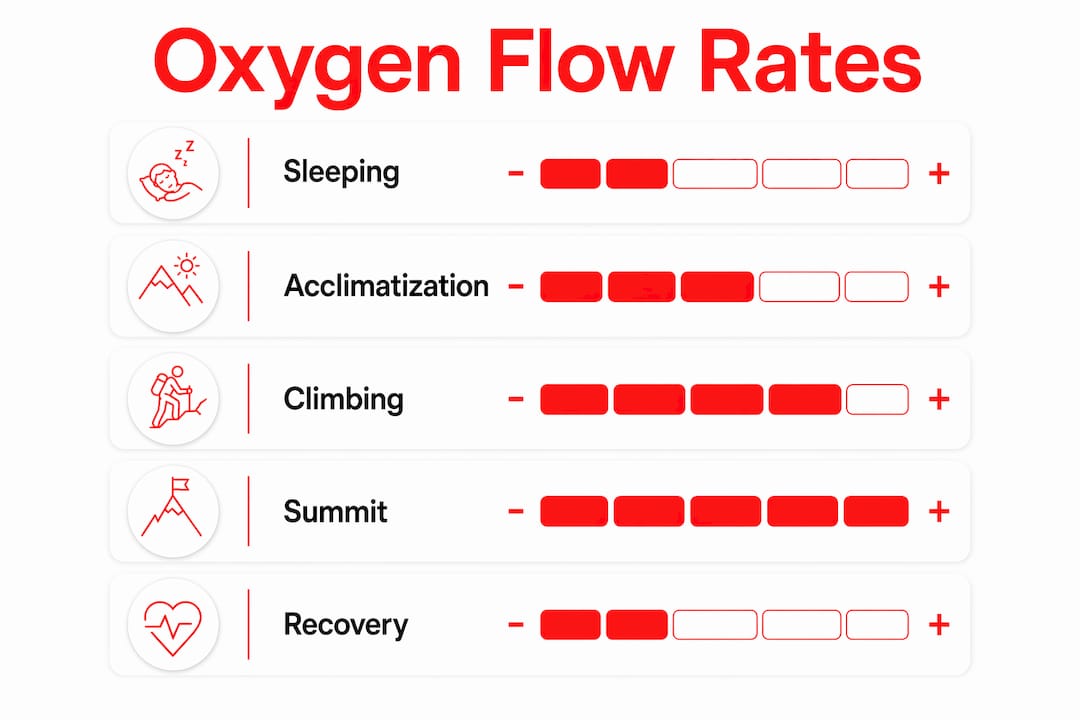
Adjusting flow rates between 1–4 L/min involves real tradeoffs. Lower rates conserve cylinder supply but reduce the safety margin against altitude illness. Higher rates provide better protection but can exhaust your supply before you complete the descent.
Summit day oxygen protocol
Follow this sequence on summit day to manage your supply and safety:
- Start oxygen at Camp 4 before leaving. Turn on your regulator and confirm flow before stepping outside. Cold temperatures cause regulator failures, and you want to catch problems in camp, not on the Lhotse Face.
- Set flow to 3 L/min for the initial climb. This conserves supply during the lower-angle terrain between Camp 4 and the Balcony on Everest, or equivalent waypoints on other peaks.
- Increase to 4 L/min above 8,500 meters. The death zone demands maximum support. 4 L/min prevents frostbite and reduces altitude illness risk at the most critical section of the climb.
- Monitor cylinder pressure every 60–90 minutes. Calculate remaining supply against your position and turn-around time. Never assume you have enough.
- Reserve a minimum one-third cylinder for descent. Descents cause more fatalities than ascents on technical peaks. Cognitive impairment on the way down is just as dangerous as on the way up.
- Switch cylinders at pre-staged depots. Cylinder placement must be confirmed before summit day, not improvised.
Pro Tip: Tape your flow rate setting to your regulator with a small label before leaving base camp. Hypoxia impairs memory. You do not want to second-guess your setting at 8,700 meters.
What preparation does effective oxygen use require?
Logistics determine whether your oxygen strategy succeeds or fails before you leave base camp. Cylinder staging requires pre-positioning weeks ahead of your summit attempt. Mismanagement of cylinder placement has ended expeditions and contributed to fatalities. Work with your expedition team to confirm cylinder counts, regulator compatibility, and depot locations at each high camp.
Physical preparation is equally critical. Optimizing iron stores 6–8 weeks before your expedition supports the blood adaptation that makes supplemental oxygen more effective. Ferritin and total iron-binding capacity (TIBC) directly affect your body’s ability to carry oxygen in the blood. A pre-expedition blood panel with your physician can identify deficiencies before they cost you the summit.
Preparation checklist before your summit attempt:
- Confirm cylinder count, regulator type, and mask fit at base camp
- Complete all acclimatization rotations as planned; do not abbreviate them because you are using oxygen
- Get a blood panel to check ferritin levels 6–8 weeks before departure
- Practice regulator changes with gloves on at base camp
- Agree on a pre-set turn-around time with your lead Sherpa and commit to it in writing
Pre-set turn-around times enforced by lead Sherpas are a documented safety protocol that reduces death-zone fatalities. A 2:00 PM turn-around from Camp 4 on Everest is a common standard. The rule exists because hypoxia impairs the judgment needed to make that call independently.
Pro Tip: Practice breathing through your oxygen mask during acclimatization rotations at lower camps. Mask fit problems discovered at 7,000 meters are manageable. The same problem at 8,500 meters is life-threatening.
What are the most common problems with summit oxygen use?
Equipment failure is the most immediate risk. Regulators freeze in extreme cold, masks develop leaks, and cylinders can be damaged in transport. Carry a spare regulator valve and inspect all connections before leaving each camp. Oxygen logistics require rigorous systems because a single failure point can compromise the entire summit attempt.
Altitude illness can still develop despite oxygen use. Supplemental oxygen reduces risk but does not eliminate it. Watch for these warning signs even while breathing supplemented oxygen:
- Persistent headache that does not improve with increased flow rate
- Ataxia (loss of coordination) or stumbling on flat terrain
- Confusion, unusual irritability, or inability to follow simple instructions
- Dry cough that worsens with exertion, which may signal early HAPE
- Extreme fatigue disproportionate to your pace and effort level
The psychological dimension of oxygen use creates its own hazards. Climbers who feel better on oxygen sometimes push pace beyond what their body can sustain. Supplemental oxygen is a risk-mitigation tool, not a speed-enhancement tool. The primary limit remains low barometric pressure. Burning through your cylinder supply by climbing too fast leaves you exposed on the descent.
“The most dangerous mistake climbers make with supplemental oxygen is treating it as a license to push harder rather than a tool to stay safer. Oxygen improves your margin. It does not remove the mountain’s limits. Pre-set safety rules, including turn-around times and Sherpa authority, are paramount over personal ambition on summit day.”
One additional consideration for record-conscious climbers: any supplemental oxygen use invalidates a “no-oxygen” ascent claim under Himalayan Database criteria. Even brief emergency use negates the classification. If a no-oxygen ascent is your goal, that decision must be made before the climb begins, not adjusted mid-route.
Key Takeaways
Using supplemental oxygen on summit attempts requires correct flow rates, staged logistics, pre-trip physical preparation, and pre-set safety rules to deliver its full protective benefit.
| Point | Details |
|---|---|
| Flow rate determines protection | Use 4 L/min on summit day to reduce effective altitude by 1,000–1,500 meters. |
| Logistics must be pre-staged | Confirm cylinder placement and regulator compatibility weeks before summit day. |
| Oxygen does not replace acclimatization | Complete all acclimatization rotations even when using supplemental oxygen. |
| Pre-set rules save lives | Commit to a turn-around time with your lead Sherpa before leaving Camp 4. |
| Oxygen is safety, not speed | Use oxygen to maintain steady pacing and mental clarity, not to climb faster. |
What I’ve learned about oxygen use that most guides won’t tell you
Most articles on supplemental oxygen in climbing focus on flow rates and equipment. Those details matter. But the harder lesson is psychological, and it took me years of watching expeditions succeed and fail to understand it clearly.
Climbers who use oxygen well treat it as a system, not a safety net. They pre-commit to turn-around times before they feel the pull of the summit. They monitor cylinder pressure on a schedule, not when they remember to. They accept that energy management matters more than any single piece of equipment. Oxygen gives you a margin. What you do with that margin is still entirely up to you.
The 2026 data on Everest fatalities reinforces something that experienced guides have known for decades. The climbers who die are not always the least prepared. They are often the ones who let ambition override the rules they set for themselves at base camp. Oxygen can make you feel capable of more than the mountain will allow on a given day. That feeling is the most dangerous thing it produces.
My honest recommendation is this: treat your turn-around time as a non-negotiable contract, not a guideline. Give your lead Sherpa explicit authority to enforce it. And use the cognitive clarity that supplemental oxygen provides to make better decisions, not faster ones.
— Paul
Revo2 portable oxygen for your altitude preparation
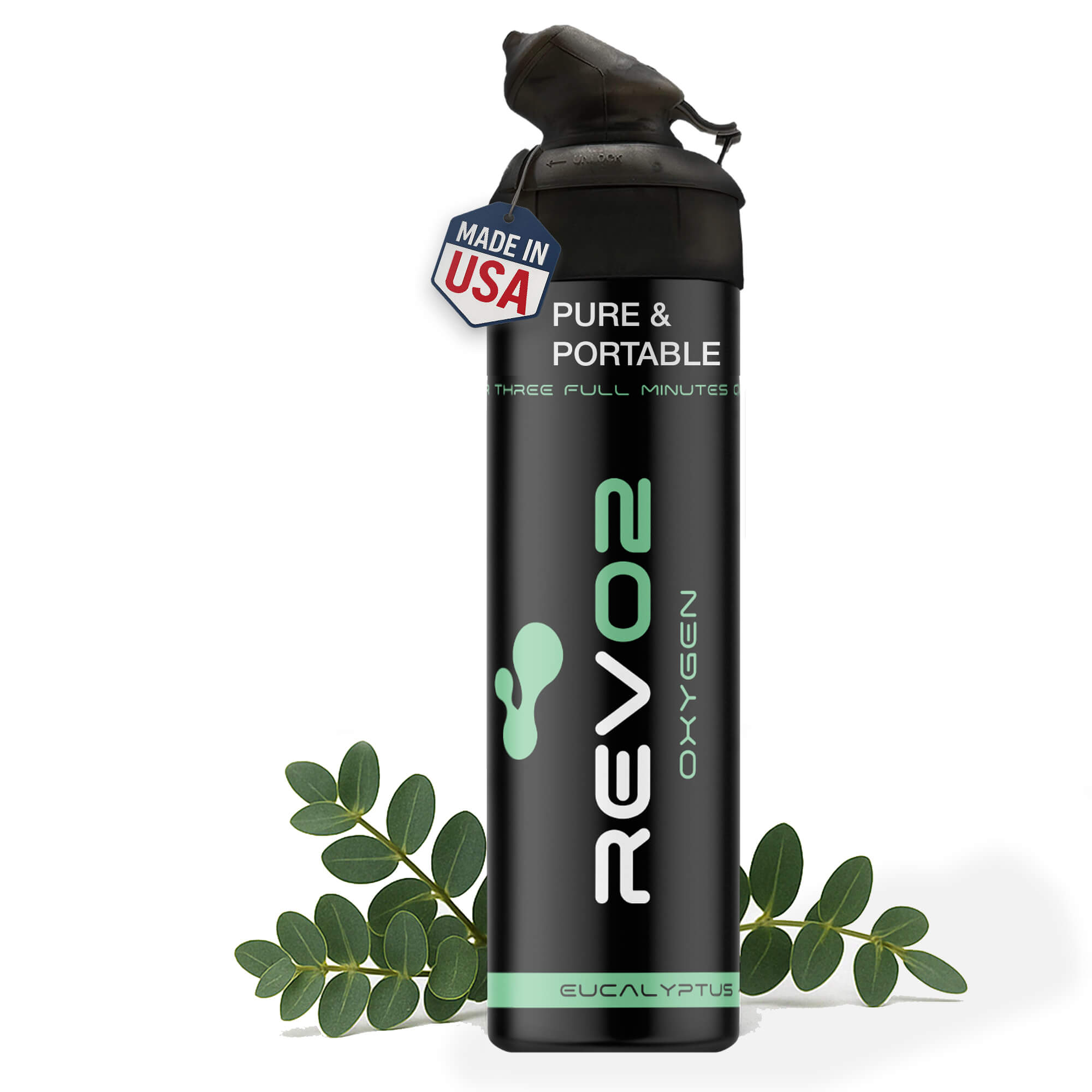
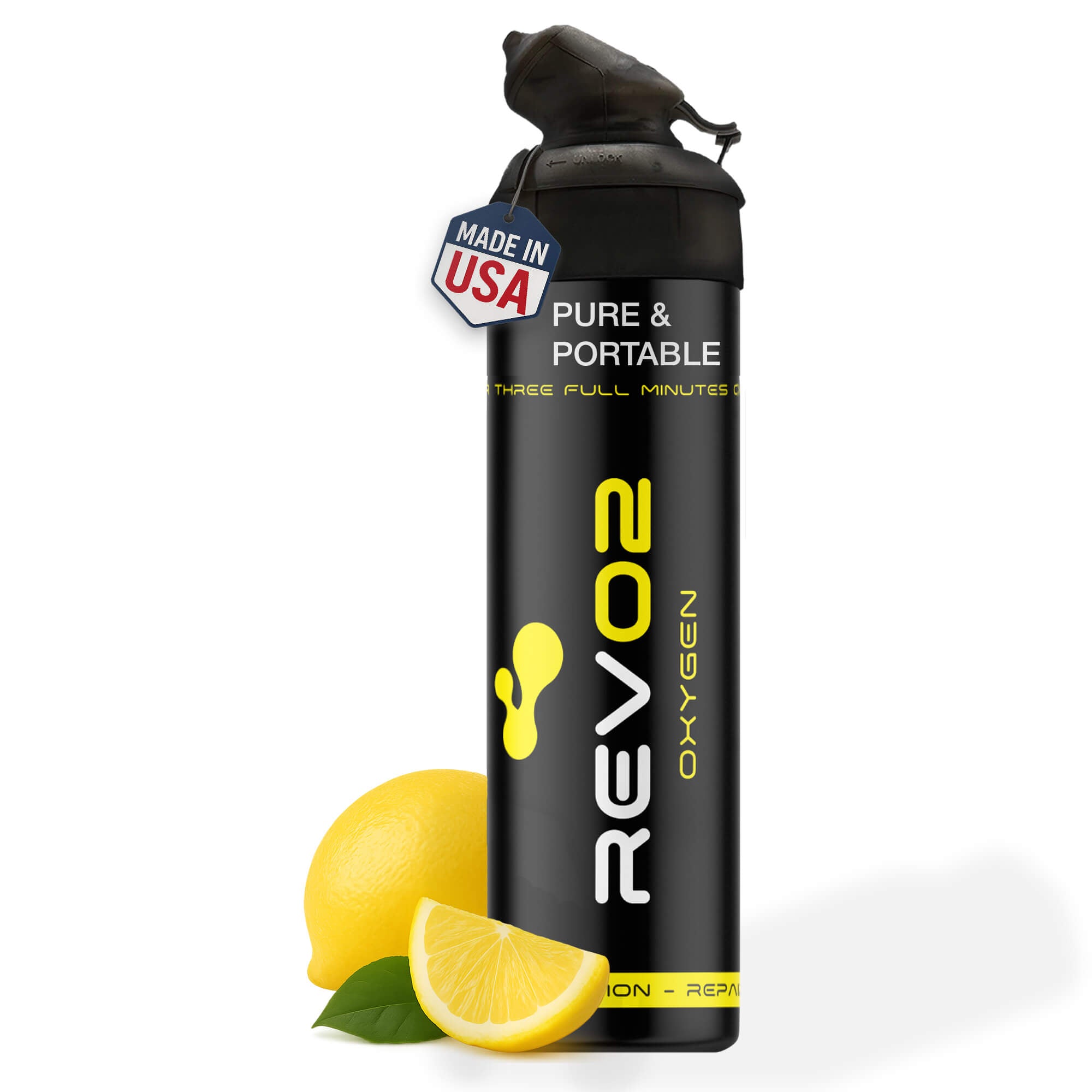
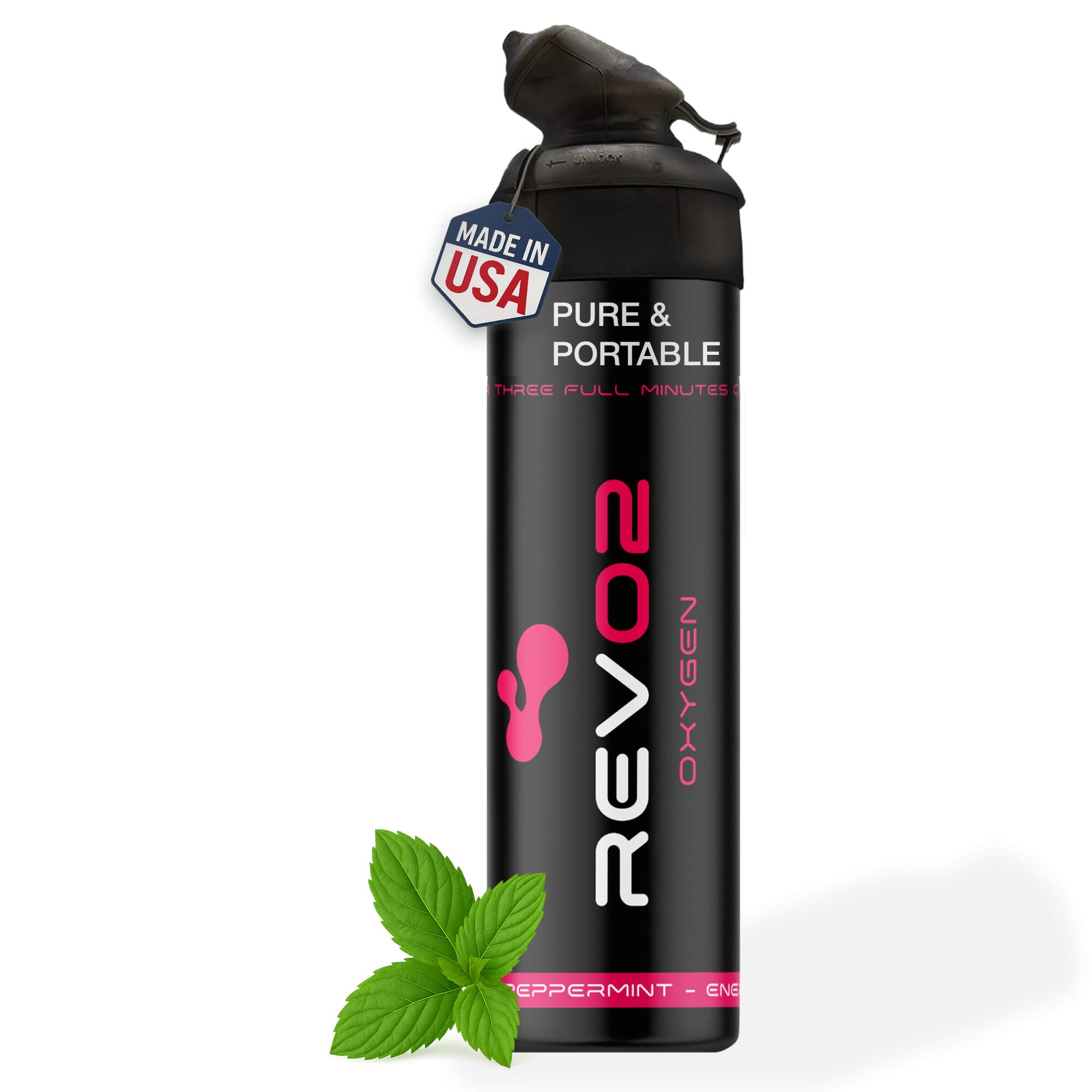
High-altitude climbers know that preparation extends beyond the mountain. Revo2’s canned oxygen products deliver 98% pure oxygen through a zero-leak mouthpiece, making supplemental oxygen accessible at every stage of your expedition preparation, from acclimatization treks to post-climb recovery.
Revo2 is designed for climbers who take their oxygen strategy seriously. The portable format fits in a pack pocket and requires no mask or regulator. Whether you are managing fatigue at a high camp or supporting recovery between acclimatization rotations, Revo2 gives you a reliable, portable option. Read the usage guide to understand how to integrate canned oxygen safely into your high-altitude climbing protocol.
FAQ
What flow rate should I use on summit day?
Medical guidance recommends 4 L/min on summit day for most climbers, which lowers your physiological altitude by 1,000–1,500 meters and reduces frostbite and altitude illness risk.
Can I skip acclimatization if I use supplemental oxygen?
No. Supplemental oxygen raises inspired oxygen concentration but does not change atmospheric pressure, so the blood adaptations from acclimatization remain necessary for safe high-altitude performance.
How do I know if altitude illness is developing despite oxygen use?
Watch for persistent headache, ataxia, confusion, or a worsening dry cough even while breathing supplemented oxygen. Increase flow rate immediately and descend if symptoms do not improve within 30 minutes.
Does using any oxygen disqualify a no-oxygen ascent record?
Yes. Under Himalayan Database criteria, any supplemental oxygen use, including brief emergency use, invalidates a no-oxygen ascent classification.
How far in advance should I stage oxygen cylinders?
Cylinder pre-positioning should be completed weeks before your summit attempt. Late or incomplete staging is one of the most common logistical failures on high-altitude expeditions.