
Supplemental oxygen reduces brain fog by delivering concentrated oxygen directly to under-oxygenated brain regions, restoring the cellular conditions your brain needs to think clearly. The clinical term for this intervention is oxygen therapy, which ranges from portable canned oxygen to hyperbaric oxygen therapy (HBOT). Both approaches share the same core mechanism: raising blood oxygen levels above what ambient air provides. Research shows that oxygen therapy for brain fog can increase dissolved oxygen in the blood significantly, suppressing neuroinflammation and triggering brain repair processes. If you have been struggling with mental fatigue, slow thinking, or poor recall, understanding this physiology is the first step toward doing something about it.
What is brain fog and why does oxygen deficiency worsen it?
Brain fog is not a medical diagnosis. It is a cluster of cognitive symptoms that signal your brain is not functioning at full capacity. Those symptoms include:
- Difficulty concentrating on tasks that previously felt routine
- Short-term memory lapses, such as forgetting words mid-sentence
- Mental fatigue that arrives early in the day and does not lift
- Slowed processing speed, where thinking feels like wading through mud
- Confusion or disorientation in familiar situations
The brain is uniquely vulnerable to oxygen shortfalls because it stores no oxygen of its own. It consumes roughly 20% of the body’s total oxygen supply despite making up only about 2% of body weight. That demand is constant, and any drop in delivery has immediate consequences.
When oxygen supply falls, neurons shift into an emergency state. Glutamate, the brain’s primary excitatory neurotransmitter, accumulates to toxic levels. That buildup damages synaptic connections and disrupts the electrochemical signals that underpin memory, attention, and decision-making. Research confirms that severe brain damage becomes irreversible within 5–15 minutes without oxygen. Even mild, chronic oxygen shortfalls well below that threshold produce the foggy, fatigued cognition many people experience daily.
Conditions that reduce oxygen delivery include sleep apnea, anemia, poor cardiovascular function, high-altitude exposure, and chronic stress. Stress is particularly insidious because the “fight or flight” response redirects blood flow away from the prefrontal cortex, the region responsible for planning and focus. The result is a vicious cycle: stress reduces oxygenation, reduced oxygenation worsens cognitive performance, and poor cognitive performance increases stress.
How does supplemental oxygen work biologically to clear brain fog?
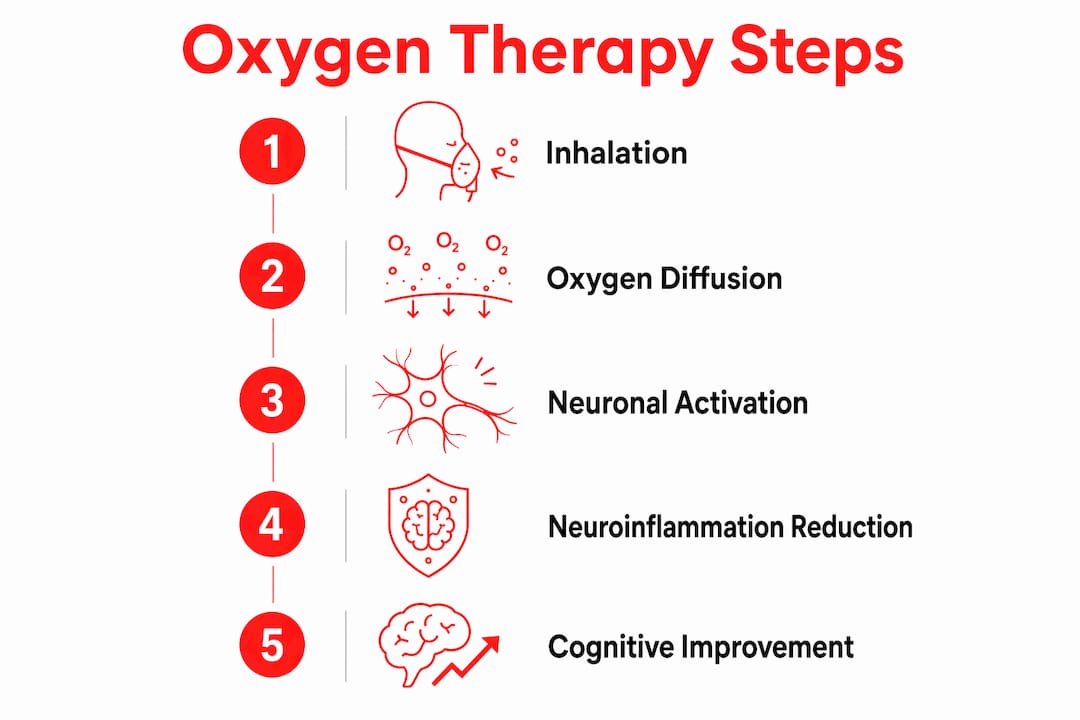
Supplemental oxygen improves cognitive function through four distinct biological mechanisms. Each one builds on the last, which is why consistent use over time produces stronger results than a single session.
-
Increased plasma oxygen and tissue diffusion. Under normal conditions, oxygen travels through the blood bound to hemoglobin. When you breathe concentrated oxygen, additional oxygen dissolves directly into blood plasma. That dissolved oxygen diffuses into brain tissue through concentration gradients, reaching hypoperfused brain regions that compromised blood flow cannot adequately supply. HBOT protocols at pressures of 1.5–2.0 ATA breathing 100% oxygen can raise brain tissue oxygen from a normal 30–40 mmHg to over 200 mmHg. That is a dramatic shift that saturates areas previously starved of fuel.
-
Suppression of neuroinflammation. Oxygen deprivation triggers the release of inflammatory cytokines, chemical signals that damage neurons and disrupt synaptic function. Supplemental oxygen reverses this by reducing the production of those cytokines. Lower neuroinflammation means neurons can communicate more efficiently, which translates directly into sharper thinking and faster recall.
-
Activation of the protective glutamate switch. Excess glutamate is one of the primary drivers of cognitive impairment during hypoxia. Supplemental oxygen activates a metabolic switch that converts toxic glutamate into a non-harmful compound, protecting synapses from further damage. This mechanism explains why people often report a noticeable mental lift within minutes of using supplemental oxygen.
-
Stimulation of angiogenesis, neuroplasticity, and mitochondrial biogenesis. Repeated oxygen exposure upregulates brain-derived neurotrophic factor (BDNF) and vascular endothelial growth factor (VEGF). BDNF supports the formation of new neural connections, while VEGF triggers angiogenesis, the growth of new blood vessels. Mitochondrial biogenesis, the creation of new cellular energy factories, increases the brain’s long-term capacity to sustain focus and resist fatigue.
Pro Tip: If you use portable supplemental oxygen for a quick cognitive lift, breathe slowly and steadily through the mouthpiece rather than taking rapid shallow puffs. Slower inhalation maximizes the time oxygen spends in contact with lung tissue, improving absorption.
What does the clinical evidence say about oxygen and cognitive improvement?

Controlled trials provide the clearest picture of how oxygen therapy for cognitive function performs in practice. A 2026 trial using 20 HBOT sessions over four weeks showed significant cognitive improvement across multiple measures. A separate study of 116 post-stroke patients found that combined HBOT and cognitive training produced greater gains in both cognitive scores and daily living function than either treatment alone, measured by the Mini-Mental State Examination (MMSE) over 20 sessions across four weeks.
The results are real, but they are not universal. Clinical data shows that 56–63% of patients report meaningful cognitive improvement after structured oxygen therapy. That leaves 13–19% who see no benefit or experience deterioration. Those numbers underscore why patient screening matters before starting any protocol.
| Population | Reported improvement rate | Key outcome measured |
|---|---|---|
| Long COVID brain fog patients | 56–63% | Cognitive clarity, memory, processing speed |
| Post-stroke patients (HBOT + cognitive training) | Greater than either alone | MMSE score, daily function |
| Patients with insufficient treatment duration | Low | Minimal cellular repair observed |
“Protocol consistency is critical. Daily sessions Monday through Friday over several weeks are needed to drive the deep cellular repair that produces lasting cognitive gains.” — Emergency physician Craig Lindsey, as cited in Scientific American
The medical community continues to assess which patient profiles benefit most, with conflicting evidence emerging from high-intensity versus shorter trials. What the data consistently shows is that duration and frequency are not optional variables. Many patients fail to improve simply because they stop treatment too early, before cumulative oxygen exposure has had time to stimulate angiogenesis and mitochondrial biogenesis at the cellular level.
Who benefits most from supplemental oxygen, and how should you use it?
Not everyone responds to oxygen therapy the same way. Understanding your profile helps you set realistic expectations and use supplemental oxygen safely.
People most likely to benefit include:
- Long COVID patients experiencing persistent brain fog after viral illness
- High-altitude travelers and athletes whose oxygen saturation drops below optimal levels
- Older adults with age-related reductions in cerebral blood flow
- People with sleep apnea who experience chronic nocturnal hypoxemia
- Individuals under high cognitive or physical stress who need rapid mental recovery
Home oxygen therapy is designed to reduce hypoxemia and cardiopulmonary stress, improving activity tolerance and supporting daily function. For people with chronic oxygen deficits, consistent supplemental use can meaningfully restore baseline cognitive performance.
Practical usage guidelines matter as much as the oxygen itself. For clinical HBOT, the evidence points to daily sessions five days per week for a minimum of four weeks. For portable supplemental oxygen, short sessions of several inhalations during periods of mental fatigue or after physical exertion are the most common and practical approach.
Oxygen therapy is not without risk. In people with certain respiratory conditions, such as chronic obstructive pulmonary disease (COPD), excess oxygen can suppress the hypoxic drive to breathe and cause CO2 retention, a condition called hypercapnia. That worsens rather than relieves cognitive symptoms. For guidance on safe oxygen use with COPD, professional oversight is non-negotiable.
Pro Tip: If you have any pre-existing respiratory condition, ask your physician to titrate your oxygen dosage before starting any supplemental oxygen protocol. Overexposure carries real risks, and a simple blood gas test can establish a safe starting point.
Key Takeaways
Supplemental oxygen reduces brain fog by raising tissue oxygen levels, suppressing neuroinflammation, and activating cellular repair processes that restore cognitive function over time.
| Point | Details |
|---|---|
| Oxygen deficiency drives brain fog | The brain stores no oxygen and deteriorates rapidly when supply drops, producing confusion, fatigue, and memory lapses. |
| Four biological mechanisms explain the benefit | Plasma diffusion, cytokine suppression, glutamate metabolism, and BDNF/VEGF upregulation all contribute to cognitive recovery. |
| Clinical results are real but variable | 56–63% of patients improve with structured therapy; protocol consistency over weeks is the strongest predictor of success. |
| Screening prevents harm | Respiratory conditions like COPD require professional titration to avoid CO2 retention and worsened symptoms. |
| Portable oxygen offers accessible support | Short sessions with high-purity supplemental oxygen can provide a practical cognitive lift between clinical treatments. |
My honest read on oxygen therapy for brain fog
Paul here. After years of reviewing the clinical literature on cognitive recovery, one pattern stands out clearly: the people who get the most from oxygen therapy are the ones who treat it like a structured protocol, not a quick fix. The 56–63% improvement rate in controlled trials is genuinely encouraging. But those trials used daily sessions over multiple weeks. The people who try a handful of sessions and declare it ineffective are not testing the therapy. They are testing their patience.
What I find most compelling is the glutamate mechanism. The idea that supplemental oxygen can flip a metabolic switch that neutralizes one of the brain’s most damaging byproducts is not speculative. It is supported by reproducible biochemistry. That said, I am cautious about the enthusiasm around portable canned oxygen as a standalone cognitive treatment. It is a useful tool for acute mental fatigue, altitude exposure, and recovery support. It is not a substitute for a supervised HBOT protocol in people with significant neurological impairment.
The screening issue is the one I feel most strongly about. Oxygen is a drug in the physiological sense. Giving it to someone with undiagnosed COPD without titration is not harmless. The cognitive clarity you are chasing could be replaced by hypercapnia if the dosage is wrong. Get evaluated first. Then use the tool.
— Paul
Revo2 and the case for portable oxygen clarity
Mental fatigue does not always wait for a clinic appointment. For people who need cognitive support between structured sessions, or who simply want a practical way to counter the effects of stress, altitude, or a long workday, portable supplemental oxygen fills a real gap.
Revo2 delivers 98% pure oxygen in a portable can with a zero-leak mouthpiece, so every inhalation counts. The design removes the waste and complexity of traditional oxygen delivery systems. Whether you are recovering from a demanding workout, working through afternoon mental fatigue, or traveling at altitude, Revo2 canned oxygen gives your brain the fuel it needs, fast. For those new to supplemental oxygen, the usage guide walks you through safe and effective technique from the first breath.
FAQ
What exactly is brain fog?
Brain fog is a set of cognitive symptoms including poor concentration, memory lapses, mental fatigue, and slowed thinking. It signals that the brain is not receiving or processing enough oxygen to function at full capacity.
How does supplemental oxygen reduce brain fog?
Supplemental oxygen increases dissolved oxygen in the blood, which diffuses into under-oxygenated brain tissue, suppresses neuroinflammation, and activates a protective metabolic switch that neutralizes toxic glutamate buildup.
How long does it take for oxygen therapy to improve cognitive function?
Clinical trials using 20 sessions over four weeks show significant cognitive improvement in the majority of patients. Portable oxygen can provide a faster but shorter-term lift during acute mental fatigue.
Is supplemental oxygen safe for everyone?
No. People with respiratory conditions like COPD face the risk of CO2 retention if oxygen is not properly titrated. Professional screening is required before starting any structured oxygen therapy protocol.
Can portable canned oxygen help with brain fog?
Yes, within limits. Portable supplemental oxygen is effective for acute cognitive fatigue, altitude-related impairment, and recovery support. For deeper neurological repair, a supervised clinical protocol remains the most evidence-backed approach.