

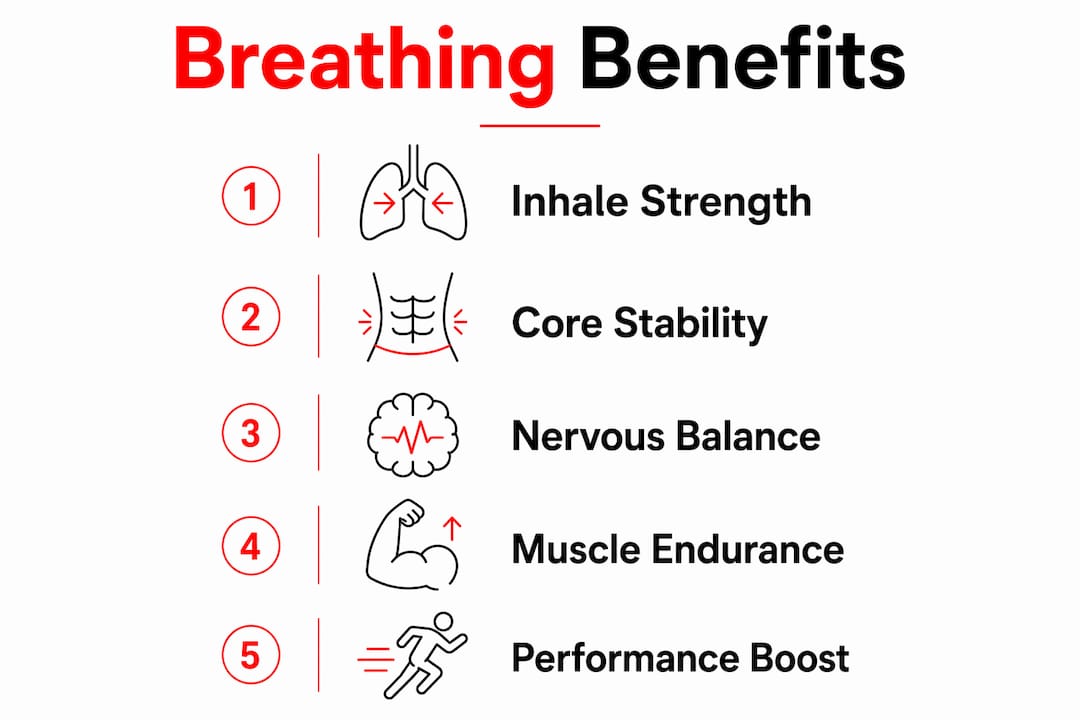
Breathing technique directly determines how much force you produce, how stable your core stays, and how quickly your nervous system recovers between sets. This is not a peripheral detail. Exhaling during the concentric phase of a lift optimizes intra-abdominal pressure, stabilizes the spine, and increases power output, while inhaling during that same effort reduces performance and elevates cardiovascular strain. Beyond the weight room, controlled breathing patterns regulate your autonomic nervous system, shifting you between the focused alertness you need mid-workout and the parasympathetic recovery state your body needs afterward.
Here is what the research shows matters most:
- Exhale on effort. Breathing out during the concentric (exertion) phase maximizes core stability and force output.
- Avoid inhaling under load. Inhalation during lifting reduces training volume and increases physiological stress.
- Use slow-paced breathing off the field. Voluntary slow-paced breathing (SPB) activates the vagus nerve, reducing anxiety and accelerating recovery.
- Train your respiratory muscles. Respiratory muscle training (RMT) reduces perceived breathlessness and lets you sustain higher intensities longer.
- Match breathing to training type. Endurance, strength, and high-intensity interval training each call for different breathing strategies.
Table of Contents
- Why breathing technique matters in training: the physical performance case
- How breathing regulates your nervous system and mental performance
- Respiratory muscle training builds the endurance your lungs need
- Practical steps for applying better breathing in every training session
- Key Takeaways
Why breathing technique matters in training: the physical performance case
Your breath is a mechanical force, not just a gas exchange mechanism. How and when you breathe during strength training directly affects muscle engagement, core stability, power output, and the position of your rib cage, spine, and pelvis. The diaphragm functions as a core stabilizing muscle, working alongside the pelvic floor, deep abdominals, and back muscles to create the internal abdominal pressure that supports every heavy movement you make.
A peer-reviewed study on bench press performance found that inhalation during lifting resulted in significantly lower set completion and training volume compared to exhalation or breath-holding. Heart rate variability parameters also dropped during concentric inhalation, signaling reduced parasympathetic activity and elevated physiological stress. Exhalation during the lift, by contrast, supported greater mechanical efficiency and autonomic stability.
Breath-holding, often called the Valsalva maneuver, can momentarily improve core stability and help with very heavy loads. But the metabolic costs of sustained breath-holding outweigh the stabilization benefits by elevating intrathoracic pressure and cardiovascular load. Rhythmic exhalation remains the safer, more sustainable strategy for most training contexts.
Poor technique also triggers what researchers describe as protective tension: inhaling during forceful movements causes the nervous system to limit muscle activation as a protective response, reducing strength output independent of actual muscle capability.
Best breathing practices for physical exertion:
- Exhale during the concentric (lifting, pushing, pulling) phase
- Inhale during the eccentric (lowering, releasing) phase
- Reserve breath-holding for maximal single-rep efforts only
- Keep breathing rhythmic to maintain neuromuscular efficiency
- Learn how breathing affects performance across different training modalities
How breathing regulates your nervous system and mental performance
Breathing is one of the few physiological processes you can consciously control, and that control gives you direct access to your autonomic nervous system. Voluntary slow-paced breathing activates the vagus nerve, increasing parasympathetic activity, lowering heart rate, and producing a measurable calming effect on both body and mind. For athletes managing pre-competition anxiety or post-training recovery, this is a practical tool, not a wellness cliché.
Research published in a sports psychology review found that fast-paced breathing increases sympathetic activity, priming fast-twitch muscle fibers and sharpening reaction time, while slow-paced breathing enables emotional regulation, improved attention, and flexible thinking. These are not interchangeable. Choosing the wrong pattern at the wrong moment, such as hyperventilating before a precision event, can actively impair performance.
Slow-paced breathing practiced consistently before or after training sessions has shown benefits across basketball, swimming, running, cycling, and dancing. Cognitive improvements include better working memory, inhibition control, and concentration, all of which translate directly to athletic decision-making under pressure. For anxiety management specifically, nasal breathing tends to produce slower, deeper breaths that stimulate the parasympathetic nervous system and reduce the physical symptoms of performance anxiety.
Key breathing techniques and their mental performance effects:
- Slow-paced breathing (SPB): Reduces anxiety, improves focus, supports post-exercise recovery
- Fast-paced breathing (FPB): Increases alertness and energy for explosive efforts
- Nasal breathing: Slows respiration naturally, promotes parasympathetic calm
- Box breathing (4-count in, hold, out, hold): Grounds attention and lowers nervous system arousal before competition
- Voluntary hyperventilation: Useful for sprint recovery phases; avoid in balance-dependent sports
Respiratory muscle training builds the endurance your lungs need
Respiratory muscle training, or RMT, applies the same overload principle to your breathing muscles that strength training applies to your legs or shoulders. The diaphragm and intercostal muscles fatigue during sustained exercise, and that fatigue contributes to the sensation of breathlessness that limits performance well before your legs give out. RMT improves inspiratory muscle strength and endurance, reducing perceived breathlessness and effort so you can sustain higher intensities for longer.
The mechanism behind this is called desensitization to loading. After RMT, ventilation requires a lower proportion of your maximum inspiratory strength, so breathing feels less taxing at any given workload. Both perceived breathlessness and overall perceived exertion decrease, and the metaboreflex, the reflex that diverts blood from working muscles to the respiratory muscles under strain, occurs at a higher exercise intensity. That means more blood stays in your legs, arms, or wherever you need it most.
Matching RMT protocols to sport-specific demands produces the greatest gains. Threshold and targeted resistive training yield the strongest improvements in maximal inspiratory pressure. Normocapnic hyperpnea, which involves sustained high-velocity breathing, more closely mirrors the demands of cycling and other high-ventilation sports.
RMT protocols and their effects:
- Pressure-threshold training: Breathe through a resistance device for a set number of breaths; builds inspiratory muscle strength
- Normocapnic hyperpnea: Sustained high-rate breathing at controlled CO2 levels; best for endurance athletes
- Targeted resistive training: High-load, flow-controlled resistance; improves maximal inspiratory pressure
- CO2 tolerance training: Increases endurance capacity by shifting fatigue thresholds beyond what oxygen intake alone can achieve
Practical steps for applying better breathing in every training session
Applying these principles does not require a complete overhaul of your training program. Small, consistent adjustments to when and how you breathe compound into measurable performance gains over weeks.
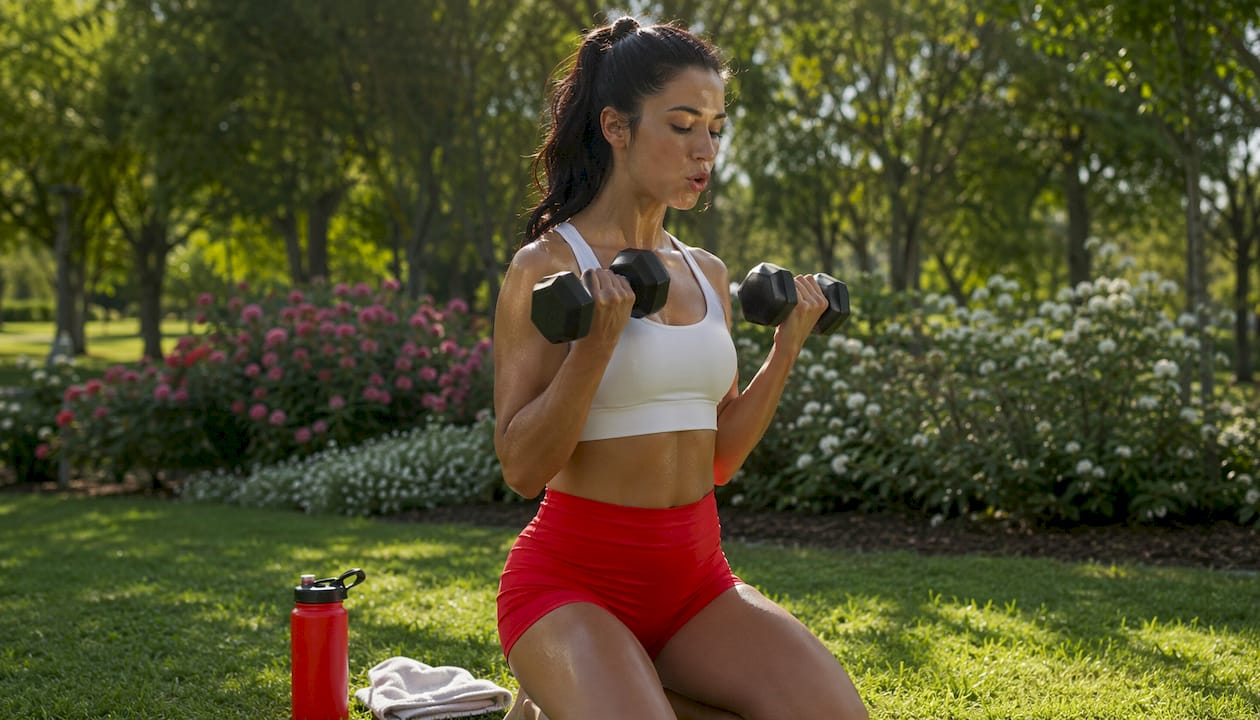
For resistance training, the rule is straightforward: exhale on the way up, inhale on the way down. This single adjustment stabilizes your core, protects your cardiovascular system, and reduces perceived effort. For endurance work, focus on rhythmic nasal breathing at lower intensities to build CO2 tolerance and improve oxygen efficiency. During high-intensity interval training, controlled fast-paced breathing during work phases and deliberate slow-paced breathing during rest periods help you recover faster between efforts.
Off the field, a daily slow-paced breathing practice of 5–10 minutes, whether through box breathing, diaphragmatic breathing, or guided breathwork, builds the autonomic adaptations that carry over into competition. Explore breathing improvement techniques that fit your specific training schedule and recovery needs.
Pro Tip: Pair your post-workout breathing practice with Revo2’s 98% pure oxygen. Inhaling supplemental oxygen during your cool-down supports faster oxygen saturation recovery and complements the parasympathetic shift you are actively training your nervous system to make.
Common breathing mistakes and how to fix them:
- Inhaling during the lift: Switch to exhaling on every concentric phase, starting with lighter loads until the pattern becomes automatic
- Holding breath throughout a set: Reserve Valsalva for true maximal efforts; default to rhythmic exhalation
- Mouth breathing during low-intensity cardio: Shift to nasal breathing to slow respiration and improve CO2 tolerance
- Skipping respiratory warm-ups: Add 10–15 deep diaphragmatic breaths before training to prime your breathing muscles
- Ignoring recovery breathing: Use slow-paced breathing immediately post-exercise to accelerate nervous system recovery
Revo2’s pure oxygen cans are designed to complement these practices, providing 98% pure oxygen through a zero-leak mouthpiece for clean, efficient inhalation. Whether you are recovering between sets, managing altitude-related oxygen reduction, or supporting mental clarity after a demanding session, supplemental oxygen works alongside trained breathing patterns, not as a replacement for them.

Key Takeaways
Proper breathing technique is the single most controllable variable that affects force production, nervous system state, and endurance capacity across every type of training.
| Point | Details |
|---|---|
| Exhale on every concentric phase | Exhalation during lifting stabilizes the core and protects cardiovascular function better than inhalation. |
| Slow-paced breathing regulates the nervous system | Vagus nerve activation through SPB reduces anxiety and accelerates post-exercise recovery. |
| RMT reduces perceived effort | Respiratory muscle training lowers breathlessness ratings, letting athletes sustain higher intensities longer. |
| Match breathing to training type | Endurance, strength, and interval training each require distinct breathing strategies for optimal output. |
| Supplemental oxygen complements trained breathing | Revo2’s pure oxygen supports oxygen saturation recovery when paired with deliberate breathing practices. |