
For most healthy people, a puff or two from a canned oxygen product produces a brief, mild, mostly subjective lift, not a measurable jump in blood oxygen. The evidence base is thin, experts at CU Anschutz describe the effect as fleeting, and canned oxygen isn’t FDA-approved as a medical therapy. It’s a wellness product, not a substitute for prescribed oxygen or emergency care, and Revo2 says so plainly as the maker of one.
TL;DR:
- A quick puff from canned oxygen provides only a fleeting subjective lift and does not measurably increase blood oxygen levels in healthy individuals.
- Delivery methods and mouthpiece design significantly affect how much inhaled oxygen actually reaches the bloodstream, which remains minimal in consumer cans.
- Scientific evidence supporting health benefits from canned oxygen is weak, limited to anecdotal reports and expert opinion, with no peer-reviewed trials confirming long-term effects.
- Canned oxygen is safe for brief use by healthy people but should never replace proper medical evaluation or treatment during respiratory distress or altitude sickness.
- Under regulation as a wellness product, canned oxygen’s purity claims do not imply clinical efficacy, and marketing often overstates potential benefits.
Table of Contents
- How Inhaled Oxygen Affects the Body (And Why a Quick Puff Doesn’t Do Much)
- What the Research and Medical Experts Actually Say
- When Canned Oxygen Helps (And When It Doesn’t)
- The Real Risks: False Security, Regulation Gaps, and Marketing Overreach
- How to Use Canned Oxygen Safely, If You Choose To
- Legal Regulations and Standards Governing Canned Oxygen Products
- Environmental Impact and Sustainability Considerations
- Where Revo2 Comes Down on the Evidence
- Try a Responsibly Made Recreational Option
- Sources
How Inhaled Oxygen Affects the Body (And Why a Quick Puff Doesn’t Do Much)
Your blood is already carrying almost all the oxygen it can hold. Hemoglobin, the protein in red blood cells that ferries oxygen to your tissues, runs at 95 to 100 percent saturation in most healthy adults at sea level. There isn’t much room left to improve on that number, which is the physiological reason canned oxygen struggles to move the needle for the average user.
Raising blood oxygen meaningfully requires sustained, continuous flow. In a hospital or ambulance, that means liters per minute delivered through a nasal cannula or mask, often for minutes to hours depending on the condition being treated. A one-second puff from a can is a completely different dose. CU Anschutz researchers point out that consumer cans lack the medical-grade delivery systems that make clinical oxygen effective, so the fraction of oxygen you actually inhale, versus what mixes with ambient air around a loose mouthpiece, drops fast.
There’s another wrinkle: your body cannot bank oxygen for later. Whatever modest boost a few breaths might provide fades within roughly 5 to 10 minutes once you stop inhaling, since your body returns to its baseline saturation almost immediately. You can’t “load up” on oxygen before a hike or a workout and expect it to carry over.
A few numbers put the delivery gap in perspective:
- Typical consumer cans hold somewhere around 5 to 10 liters of total oxygen, compared to continuous clinical flow rates measured in liters per minute, sustained far longer.
- A resting adult moves roughly 6 liters of air per minute through the lungs, so a can empties in a handful of breaths, not the sustained exposure that raises saturation.
- Purity claims like “95% oxygen” describe what’s in the can, not what reaches your bloodstream once it mixes with room air on the way in.
The design of the mouthpiece or mask genuinely matters here. A loose-fitting delivery method loses far more oxygen to the surrounding air than a sealed one, which is part of why delivery engineering, not just the percentage printed on the label, determines how much of that oxygen you actually get.
What the Research and Medical Experts Actually Say
The scientific record on canned oxygen is small, short-term, and heavily anecdotal. There’s no large randomized controlled trial showing durable performance or health gains from consumer oxygen cans, and most of what exists is a mix of expert commentary, public reporting, and case-level observation rather than the kind of rigorous data that supports strong medical claims.
A review of public comments published in PMC found that over-the-counter canned oxygen sits squarely in consumer-product territory. It’s not regulated as a medical device, and the review flagged troubling cases where people substituted it for prescribed oxygen therapy, a use it was never designed or tested for.
“Any benefit is likely to be brief, lasting only a few minutes, and much of what people report may be closer to a placebo response than a physiological one,” according to reporting on interviews with pulmonary and emergency medicine faculty at CU Anschutz.
Physicians interviewed for that coverage, including experts in altitude medicine, acknowledged that a brief, temporary lift is plausible for some users but stressed that repeated or prolonged use of a consumer can is nothing like clinical oxygen therapy. The gap between “might feel a little different” and “meaningfully improved my oxygenation” is where most of the marketing overreaches.
The evidence quality gap is stark: clinical oxygen therapy is backed by decades of controlled trials measuring saturation, recovery time, and outcomes in specific patient populations. Canned oxygen research consists largely of expert opinion, consumer surveys, and journalism-style field tests, with essentially no peer-reviewed trials demonstrating a durable performance or health benefit in healthy users.

Poison center guidance from Missouri adds a public-health angle: canned oxygen is generally harmless for healthy people used briefly, but the guidance warns explicitly against self-treating respiratory symptoms with it, since doing so can delay care that a person with an actual medical condition needs. Field-testing from Backpacker magazine, where a journalist hiked with a can and interviewed experts along the way, landed on a similar note: perceived benefits were real to the user but largely explained by rest, deep breathing, and expectation rather than measurable physiology.
When Canned Oxygen Helps (And When It Doesn’t)
Context changes everything with a product like this. The same can that does almost nothing for a marathoner might genuinely take the edge off a mild headache at 8,000 feet, and understanding which scenario you’re in keeps expectations honest.
- Altitude sickness (mild symptoms only). A few breaths from a can may ease mild headache or lightheadedness at altitude for some people, but it is not a substitute for descent, hydration, rest, or medical evaluation if symptoms worsen. Real acclimatization to altitude typically takes the body 24 to 48 hours, and no can shortcuts that biological timeline. Revo2’s altitude oxygen guide walks through what to realistically expect at different elevations.
- Athletic recovery. After a hard anaerobic effort, sprint intervals or a steep climb, some athletes report feeling like their breathing settles faster with a few puffs. There’s no evidence this translates into better endurance performance over repeated sessions, so treat it as a possible short-term comfort tool rather than a training aid.
- Everyday energy and fatigue. This is where placebo and aromatherapy likely do most of the work. Scented blends like peppermint or eucalyptus can feel invigorating through scent and the ritual of slow, deliberate breathing, independent of the oxygen itself.
- Novelty use at oxygen bars. Recreational oxygen bars sell an experience, not a therapy. That’s a fair use case as long as it’s understood as recreational rather than medical, the same distinction that separates a canned oxygen purchase from a prescription.
Revo2’s supplemental oxygen overview breaks down which of these scenarios tend to produce the most noticeable subjective effect for hikers, travelers, and athletes specifically.
The Real Risks: False Security, Regulation Gaps, and Marketing Overreach
The biggest danger with canned oxygen isn’t the oxygen itself. It’s what people do, or don’t do, because they’re holding a can.
Experts interviewed for the CU Anschutz reporting call this the “false sense of security” problem: someone experiences real shortness of breath, chest tightness, or worsening altitude sickness, takes a few puffs from a can, feels a little better, and delays calling for help or descending. That delay can matter with conditions like high-altitude pulmonary edema or a cardiac event, where minutes count. Missouri Poison Center guidance echoes this directly, warning that canned oxygen should never replace evaluation for genuine respiratory distress.
A few other realities worth knowing before you buy:
- Canned oxygen is not FDA-approved as a medical treatment; it’s classified and sold as a consumer wellness product.
- People with COPD, asthma, or any condition involving prescribed oxygen should talk to a clinician before using an OTC can, since their oxygen needs are managed clinically, not recreationally.
- Oxygen toxicity from a brief puff is essentially a non-issue, but it becomes a real concern with prolonged exposure to high-concentration oxygen, which is a reason clinical oxygen therapy is dosed and monitored carefully.
- Watch for marketing that leans hard on a purity percentage (“98% pure!”) without ever mentioning delivery, since purity in the canister means little if half of it escapes around a loose mouthpiece.
Pro Tip: If a canned oxygen product’s marketing focuses entirely on the percentage of oxygen and never mentions how the mouthpiece or mask seals against air loss, that’s a signal to look closer before buying.
How to Use Canned Oxygen Safely, If You Choose To
Using a can wisely comes down to timing, technique, and knowing your limits.
- Reserve it for mild, transient symptoms in an otherwise healthy person, like brief lightheadedness at altitude, not for anything that feels severe or is getting worse.
- Breathe slowly and deeply rather than firing off one quick puff; several unhurried inhalations make better use of the oxygen in the can than a single second-long blast.
- Expect the effect to last only minutes. Since your body can’t store extra oxygen, don’t plan around a lingering benefit.
- Store cans away from heat and open flame, check the label for concentration and expiration, and skip it entirely if you’re already using prescribed oxygen.
Know your stop signs: persistent shortness of breath, chest pain, confusion, or worsening altitude sickness symptoms mean it’s time to seek medical care, not take another puff. Acute mountain sickness affects a meaningful share of travelers who ascend quickly above 8,000 feet, and canned oxygen has no role in managing the serious end of that spectrum.
Legal Regulations and Standards Governing Canned Oxygen Products
Canned oxygen occupies a regulatory gray zone in the United States. It’s sold as a consumer product, not a drug or medical device, which means it doesn’t go through the FDA approval process that governs prescription oxygen therapy or medical equipment. The PMC review of public comments on OTC canned oxygen notes this distinction explicitly: manufacturers can sell these cans without demonstrating clinical efficacy, because they aren’t marketed as treating, curing, or preventing any disease.
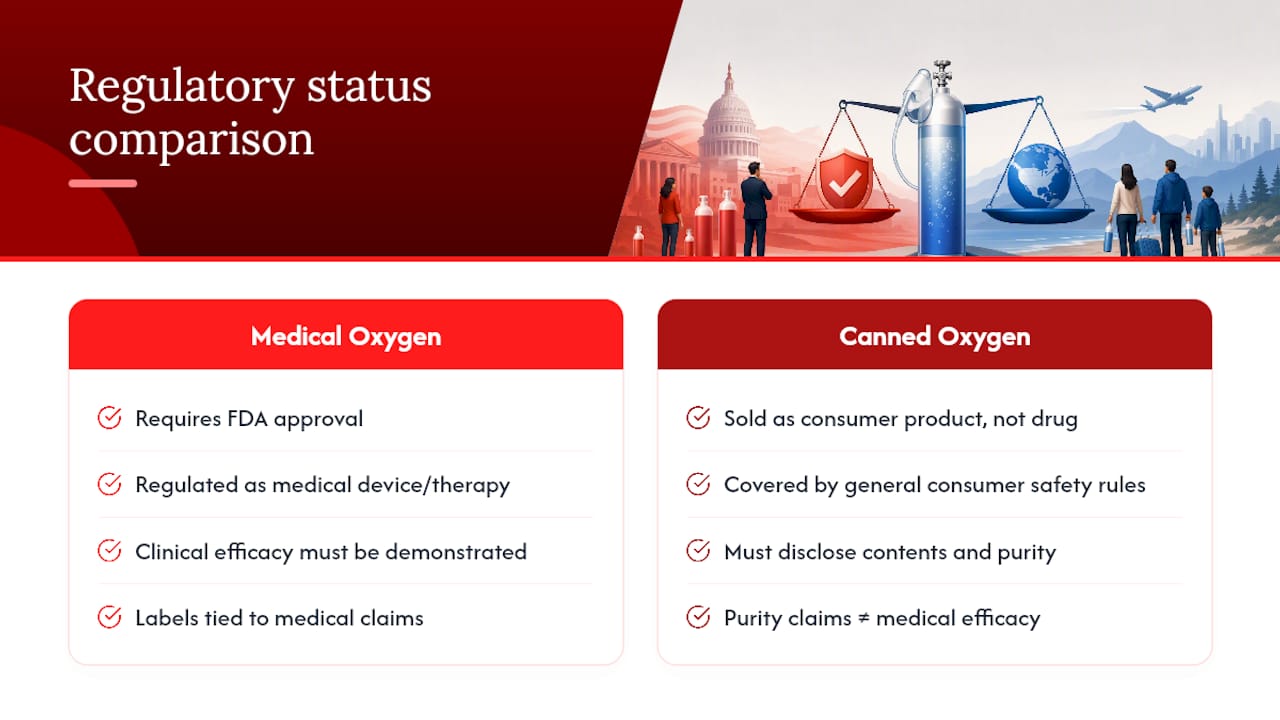
That doesn’t mean there’s zero oversight. Compressed gas canisters fall under general consumer product safety rules covering labeling, pressurized container handling, and transportation, the same category that governs things like aerosol dust removers or camping fuel canisters. Retailers and manufacturers are expected to disclose contents and purity accurately, and false or misleading health claims can draw scrutiny from consumer protection regulators even without FDA drug approval.
The practical takeaway for shoppers: a can labeled “98% pure oxygen” is making a claim about contents, not a claim about medical efficacy, and those are legally different statements. No canned oxygen product on the market today carries FDA clearance as a treatment for altitude sickness, fatigue, or any medical condition. Responsible brands are transparent about that distinction rather than letting purity percentages imply therapeutic power they haven’t demonstrated.
Environmental Impact and Sustainability Considerations
Every canned oxygen product involves manufacturing, pressurizing, and packaging a metal or composite canister, then shipping it, and that footprint is worth weighing against how the product will actually be used.
The canisters themselves are typically recyclable steel or aluminum, similar to other pressurized consumer goods, though recycling depends on local programs accepting empty pressurized containers safely. Production of the oxygen itself is relatively low-impact compared to many consumer goods since oxygen is separated from ambient air rather than synthesized from raw materials, but compressing and canning it does require energy, and transportation adds a further footprint before a can ever reaches a hiking trail or a gym bag.

For consumers weighing sustainability, a few practical questions matter more than marketing language: Is the can recyclable through standard municipal programs? Does the brand disclose materials and any takeback or recycling program? Buying larger cans less frequently, rather than a string of small ones, generally reduces the packaging-to-product ratio and cuts down on shipping trips. None of this makes canned oxygen carbon-neutral, but it puts the product in roughly the same environmental category as other portable pressurized consumer goods, not an outsized concern relative to everyday purchases.
Where Revo2 Comes Down on the Evidence
Revo2 sells canned oxygen, so it’s worth saying plainly: the honest read of the science doesn’t support treating a can as medicine, and pretending otherwise would undercut the very readers we’re trying to serve. What the evidence does support is a modest, often subjective lift for healthy people in specific moments, mild altitude discomfort, a hard recovery, a stressful afternoon, and that’s the use case worth designing around.
That’s why Revo2’s cans use a zero-leak mouthpiece rather than a loose mask. Given how much the CU Anschutz research emphasizes delivery loss as the reason purity claims overpromise, a tighter seal is the one variable a manufacturer actually controls. It won’t turn 98% purity into clinical-grade therapy, but it narrows the gap between what’s printed on the can and what a person actually inhales.
Revo2’s stance is straightforward: enjoy the subjective benefits, the calm of a slow breath, the scent, the brief lift, but never use canned oxygen as a stand-in for prescribed treatment or emergency care. If something feels seriously wrong, call a doctor, not a canister.
— Paul
Try a Responsibly Made Recreational Option
This is a wellness product, not a medical device, so if you have a cardiopulmonary condition like COPD or asthma, or you’re already using prescribed oxygen, talk to a clinician before adding it to your routine. For most healthy adults using it occasionally, a mid-size can covers a handful of sessions without over-buying, and cans should be stored away from heat and direct sun to keep the seal intact. Revo2’s usage guide walks through slow-breath technique in more depth, and the canned oxygen collection is the place to compare sizes and scent blends before your next hike, workout, or long travel day.
Sources
- Medical Use of Over-the-Counter Canned Oxygen: A Review of Public Comments
- Does Oxygen in a Can Deliver on Its Altitude and Energy Claims?
- Canned Oxygen: Is it good for you?
- Is Canned Oxygen Practical or Placebo? I Hiked With It to Find Out.
- Before you buy $20 oxygen at Yellowstone National Park, read this