
Hypoxia at high altitude happens because barometric pressure drops as you climb, which lowers the partial pressure of inspired oxygen (PiO2) even though the air is still 21% oxygen. That single physical fact triggers a cascade: lower PiO2 means lower alveolar oxygen tension, which means lower arterial oxygen tension (PaO2), which means your blood carries less oxygen to your tissues.
The numbers are predictable and well documented. For every 1,000 meters you ascend, PaO2 falls by roughly 12 mm Hg, and hypoxemia typically becomes measurable somewhere between 2,000 and 3,000 meters. At about 3,050 meters (10,000 feet), inspired PO2 sits at roughly 69% of its sea-level value, and acute exposure at that elevation can pull oxygen saturation (SaO2) down to 88 to 91%.
Here’s what matters clinically:
- PaO2 below 60 mm Hg or SaO2 under 90% defines hypoxemia and signals meaningfully abnormal oxygenation.
- Symptoms of altitude illness, including acute mountain sickness, tend to cluster once oxygenation crosses these thresholds.
- Sleep makes desaturation worse, since ventilation naturally slows overnight.
Pro Tip: If you’re planning a trip above 2,500 meters, don’t wait for symptoms to check your oxygen levels with proper high altitude travel insurance coverage to ensure evacuation and medical support if needed. A pulse oximeter costs less than a nice dinner out and tells you far more than how you “feel” about your acclimatization.
Everything downstream, from the headache on day one to the pulmonary edema that can develop in severe cases, traces back to that first pressure drop. Understanding the mechanism is what separates a scary internet search from an informed traveler.
Key Takeaways
Hypoxia at high altitude is caused by falling barometric pressure, which lowers inspired and arterial oxygen tension and drives every downstream complication from mild AMS to HACE and HAPE.
| Point | Details |
|---|---|
| Pressure, not oxygen percentage, is the trigger | Barometric pressure drop lowers PiO2 even though air stays 21% oxygen at any altitude. |
| PaO2 falls predictably with elevation | Expect roughly a 12 mm Hg drop in PaO2 for every 1,000 meters of ascent. |
| Hypoxemia has clear thresholds | PaO2 under 60 mm Hg or SaO2 under 90% marks abnormal oxygenation requiring attention. |
| Sleep is the most vulnerable period | Nocturnal desaturation often exceeds daytime drops, making sleeping altitude a key risk factor. |
| Slow ascent prevents most problems | Limiting sleeping altitude gain to 300 to 500 meters per day above 3,000 meters is the top prevention strategy. |
Table of Contents
- What Causes Hypoxia at High Altitude: The Physical Basis
- How Does Your Body Respond Immediately to Low Oxygen?
- How Does Altitude Cause HAPE and Pulmonary Hypoxia?
- What Causes HACE and Brain Swelling at High Altitude?
- What Other Factors Worsen Hypoxia at Altitude?
- What Are the Clinical Thresholds for Measuring Hypoxia?
- How Do You Prevent and Treat Altitude Hypoxia?
- What Recent Research Reveals About Altitude Hypoxia Risk
- What This Explainer Gets Right That Most Altitude Guides Miss
- Frequently Asked Questions About Altitude Hypoxia
- Sources
What Causes Hypoxia at High Altitude: The Physical Basis
Air doesn’t lose oxygen as you climb. It loses pressure. Oxygen still makes up 21% of the atmosphere at 5,000 meters, exactly as it does at sea level. What changes is the total barometric pressure squeezing that air together, and that pressure drop is what causes hypoxia at high altitude in the first place.
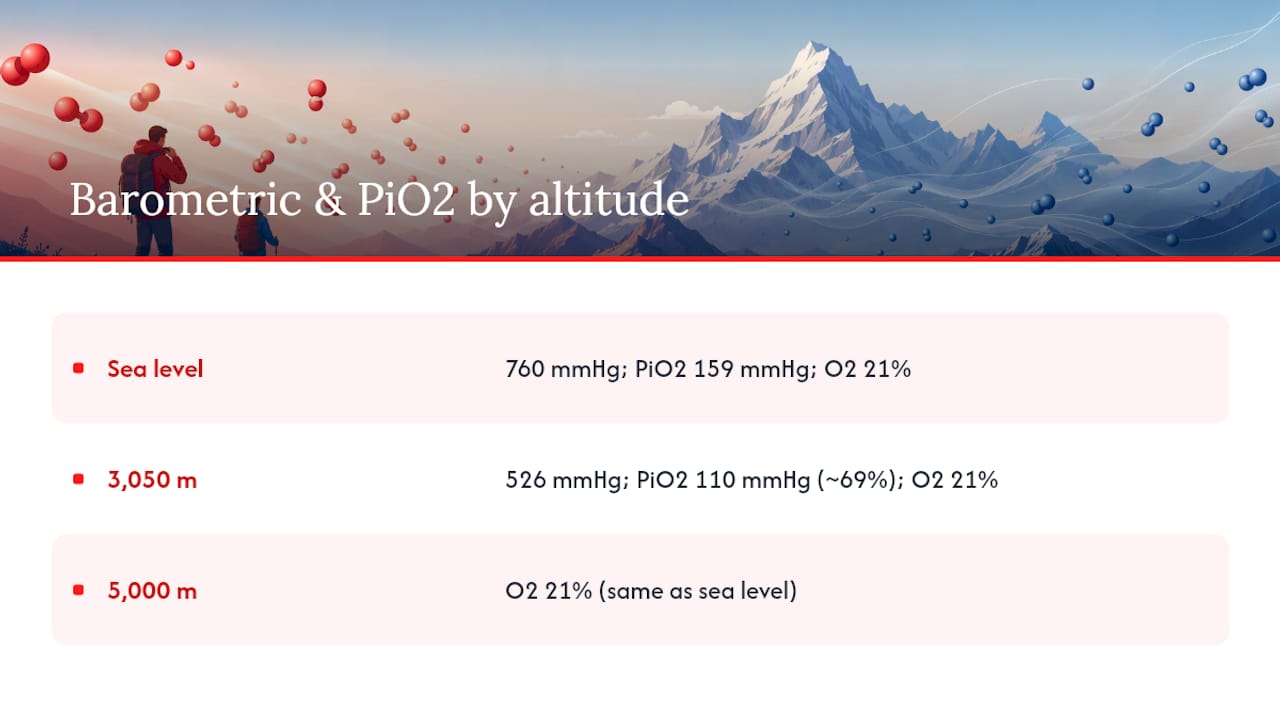
At sea level, barometric pressure runs about 760 mm Hg. Multiply that by the fraction of oxygen in air (roughly 0.21) and you get an inspired partial pressure of oxygen (PiO2) near 159 mm Hg. Climb to 3,050 meters, where barometric pressure drops to around 526 mm Hg, and PiO2 falls to about 110 mm Hg, or roughly 69% of the sea-level figure. The oxygen molecules are still there. There are simply fewer of them packed into every breath.
This is where the alveolar gas equation earns its keep. It maps how much oxygen actually reaches your alveoli after accounting for water vapor pressure in the airway and the carbon dioxide your lungs are exhaling. Simplified, alveolar PO2 (PAO2) equals PiO2 minus the ratio of arterial CO2 to the respiratory exchange ratio. As PiO2 falls with altitude, PAO2 falls with it, and PaO2 (the oxygen actually dissolved in your arterial blood) follows close behind, usually running just a few mm Hg below PAO2 in a healthy lung.
That per-1,000-meter drop of roughly 12 mm Hg in PaO2 is not a rough guideline. It’s a consistent physiological pattern documented across multiple studies of high-altitude populations, and it’s the reason clinicians can predict, with real accuracy, how oxygenation will change before a patient even leaves the exam room.
There’s a second, quieter consequence of this pressure drop: diffusion. Oxygen crosses the alveolar-capillary membrane because a pressure gradient pushes it there, from the alveolus (high PO2) into the capillary blood (lower PO2). Shrink that gradient, which is exactly what falling PiO2 does, and less oxygen crosses per unit time. At rest, your lungs usually compensate. During exercise at altitude, blood moves through the pulmonary capillaries faster, leaving less time for the same amount of oxygen to diffuse across. That’s a big part of why climbers who feel fine standing still get hit hard the moment they start moving uphill.
How Does Your Body Respond Immediately to Low Oxygen?
Your body doesn’t wait for a diagnosis. Within minutes of reaching altitude, peripheral chemoreceptors in the carotid bodies detect the falling PaO2 and fire off signals that increase your breathing rate and depth. This is the hypoxic ventilatory response (HVR), and it’s your first and fastest line of defense.
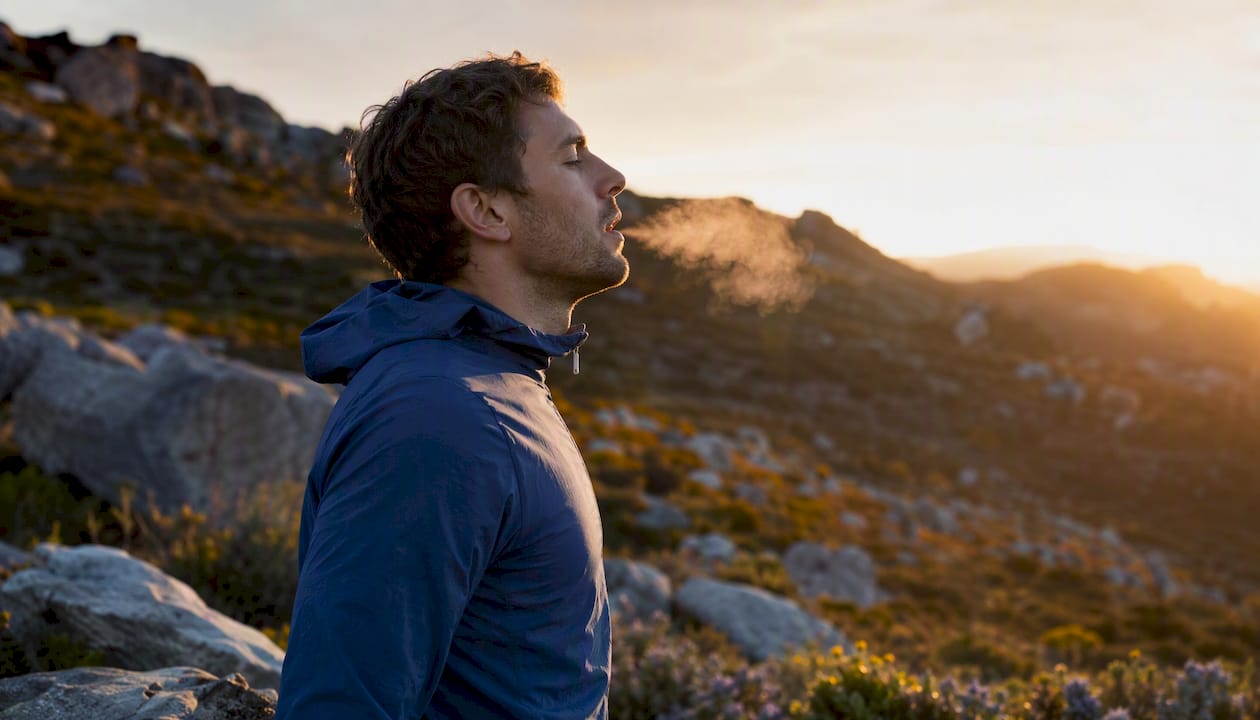
The HVR works, but it comes with a built-in complication. Breathing faster blows off more carbon dioxide, and that drop in CO2 causes respiratory alkalosis, a shift in blood pH toward the alkaline side. Your body actually resists this. Chemoreceptors sensitive to pH try to rein in the extra ventilation, creating a kind of physiological tug-of-war between the drive to get more oxygen and the drive to keep blood pH stable.
Your kidneys resolve the standoff, just not quickly. Over the following two to three days, renal bicarbonate excretion gradually corrects the alkalosis, which removes the brake on ventilation and allows breathing rate to climb further. This is a core piece of altitude acclimatization, and it explains why the second and third days at altitude often feel harder than the first: your ventilatory drive is still catching up to what your body actually needs.
Cardiovascular adjustments happen alongside this. Heart rate rises, cardiac output increases to move more blood past the lungs and deliver what oxygen there is, and total blood volume can drop as respiratory water loss and altered kidney handling reduce plasma volume, sometimes producing a mild, functional dehydration.
A few practical patterns follow from these mechanisms:
- Ventilation increases fastest in the first three to five days, with renal compensation completing acclimatization’s fastest phase within roughly that window.
- Sleep worsens hypoxemia because ventilatory drive naturally decreases during rest, and nocturnal desaturation is often the most severe oxygen drop of the entire day.
- Alcohol, sedatives, and opioids blunt the HVR directly, which is why these substances are specifically discouraged during the first nights at altitude.
How Does Altitude Cause HAPE and Pulmonary Hypoxia?
Hypoxia doesn’t just lower your oxygen levels. It actively remodels how blood flows through your lungs, and in susceptible people, that remodeling causes fluid to leak into the lungs themselves.
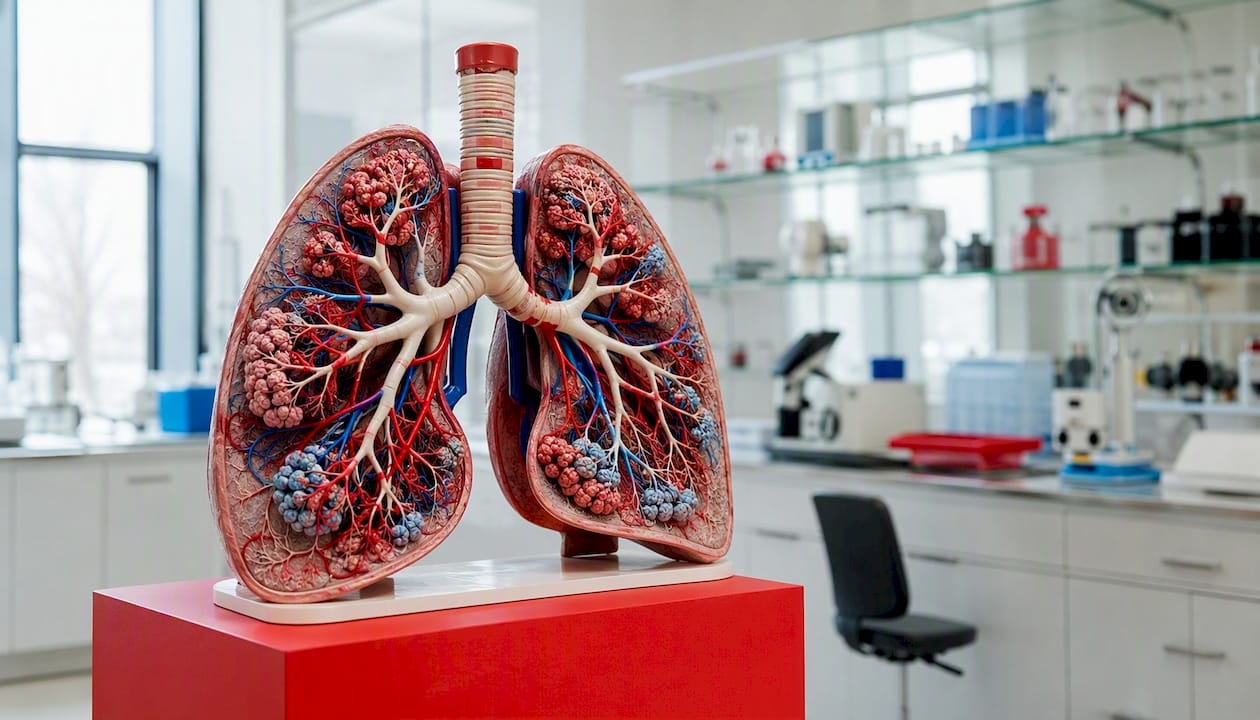
The trigger is hypoxic pulmonary vasoconstriction (HPV): when a region of lung tissue senses low oxygen, the blood vessels feeding it constrict. At sea level this is a useful reflex, redirecting blood away from poorly ventilated lung segments. At altitude, where the entire lung is hypoxic, HPV happens everywhere at once, and pulmonary artery pressure rises across the board.
The problem is that HPV isn’t perfectly uniform. It’s patchy, meaning some capillary segments constrict more than others. Blood gets diverted into the segments that resist constriction, and those segments end up overperfused, subjected to pressures well above what their capillary walls are built for. Capillary stress failure follows, the vessel walls become leaky, and protein-rich fluid seeps into the alveolar spaces. That’s high-altitude pulmonary edema (HAPE), and it’s fundamentally a mechanical and hypoxic injury rather than an infection or a heart failure process, even though it can look similar on a chest X-ray.
Hypoxia compounds its own damage here. It directly impairs the alveolar epithelium’s ability to pump sodium and, with it, fluid back out of the airspace, suppressing the Na+/K+ ATPase pump that normally keeps alveoli dry. Fluid goes in faster than it can be cleared out.
Layer diffusion limitation on top of this. During physical exertion at altitude, blood transit time through the pulmonary capillaries shortens, leaving less time for oxygen to cross into the blood even in lungs that haven’t developed edema. This widens the alveolar-arterial oxygen gradient specifically during exercise, which is why altitude illness often announces itself during a climb, not during rest at camp.
A few factors shape who ends up with clinically significant HAPE:
- Individual variability in HPV intensity, some people constrict far more aggressively than others under identical hypoxic stress.
- Genetic differences in alveolar sodium transport efficiency, affecting how well fluid clearance keeps pace with leakage.
- Rate of ascent and exertion level, both of which determine how much hypoxic stress the lungs face before acclimatization can catch up.
What Causes HACE and Brain Swelling at High Altitude?
Your brain reacts to falling oxygen levels almost as fast as your lungs do, and the reaction is the opposite of what happens to your pulmonary vessels: cerebral blood vessels dilate rather than constrict.
Two competing signals reach the brain’s blood vessels simultaneously. Hypoxia says dilate, get more blood flow to compensate for lower oxygen content. Hypocapnia, the CO2 drop from hyperventilation, says constrict. In most people at moderate altitude, hypoxic vasodilation wins the argument, and cerebral blood flow increases, sometimes substantially, in an effort to maintain oxygen delivery to brain tissue.
Increased blood flow into a rigid skull has consequences. It raises intracranial pressure, and in susceptible individuals it also triggers changes in blood brain barrier permeability. Oxidative stress from hypoxic tissue and impaired function of the Na+/K+ ATPase pump (the same pump implicated in pulmonary fluid clearance) both contribute to fluid accumulating in and around brain cells. This produces a mix of vasogenic edema (fluid leaking from vessels) and cytotoxic edema (fluid accumulating inside cells), and together they define the progression from acute mountain sickness (AMS) toward high-altitude cerebral edema (HACE).
Watch for these hallmark signs, particularly in anyone who has continued ascending despite early symptoms:
- Persistent, throbbing headache that doesn’t respond to standard pain relievers.
- Ataxia, a loss of coordination that shows up as an inability to walk a straight line.
- Confusion, drowsiness, or a noticeable change in personality or alertness.
HACE is a medical emergency. Once ataxia or altered consciousness appears, descent is not optional, it’s the treatment.
What Other Factors Worsen Hypoxia at Altitude?
Altitude hypoxia doesn’t operate in a vacuum. Several medical conditions and personal factors change how severely a given elevation affects you, and being aware of them matters more than knowing the raw physics if you’re the one climbing.
Underlying cardiopulmonary disease is the biggest wildcard. Obstructive sleep apnea, COPD, and existing heart disease all reduce your baseline oxygen reserve, meaning altitude’s normal PaO2 drop pushes you into abnormal territory faster than it would a healthy traveler. Anemia compounds the problem differently: even with normal PaO2, fewer red blood cells mean less total oxygen-carrying capacity. Pulmonary embolism can mimic or worsen altitude symptoms outright, and sedatives or opioids blunt the hypoxic ventilatory response exactly when you need it working hardest.
Behavioral and situational factors matter just as much:
| Risk factor | Why it worsens hypoxia |
|---|---|
| Rapid ascent rate | Outpaces the renal and ventilatory acclimatization timeline |
| High exertion | Shortens pulmonary capillary transit time, widening the A-a gradient |
| Higher sleeping altitude | Nocturnal ventilation drop compounds baseline hypoxemia |
| Dehydration | Reduces blood volume and circulatory efficiency |
| Cold exposure | Increases metabolic oxygen demand while impairing peripheral circulation |
Genetics add another layer entirely. Variants in EPAS1 and EGLN1, genes involved in the body’s oxygen-sensing pathway, help explain why Tibetan highland populations acclimatize differently than Andean populations, who rely more heavily on elevated hemoglobin. Certain mitochondrial DNA variants have also been linked to higher AMS susceptibility in specific groups. None of this is deterministic, but it explains why two equally fit hikers at the same elevation can have wildly different experiences. If you have any of the risk factors above, talk to a doctor experienced in altitude medicine before you go, not after symptoms start.
What Are the Clinical Thresholds for Measuring Hypoxia?
Two numbers matter most in altitude medicine: PaO2 and SaO2. PaO2, measured directly from an arterial blood sample, reflects the actual pressure of oxygen dissolved in your blood. SaO2, what a pulse oximeter estimates non-invasively, reflects the percentage of hemoglobin binding sites occupied by oxygen. PaO2 under 60 mm Hg or SaO2 under 90% defines hypoxemia in clinical terms.
A pulse oximeter is a useful field tool, but it has real limits at altitude. Cold fingers, motion during measurement, and anemia can all skew readings, and the device tells you nothing about nocturnal desaturation unless you’re wearing it while asleep. The oxygen calculator Revo2 built gives you a quick way to see how inspired oxygen availability shifts as elevation changes, which is a useful complement to an oximeter reading, not a replacement for one.
How Do You Prevent and Treat Altitude Hypoxia?
Prevention beats treatment in altitude medicine, and the prevention strategy that matters most is simple to state and hard to follow when the itinerary is tight: go slow.
The CDC recommends limiting sleeping altitude gain to 300 to 500 meters per day once above 3,000 meters, with a rest day built in every 600 to 1,200 meters of net gain. Staying hydrated and skipping alcohol and sedatives during the first nights protects the ventilatory response you’re relying on to acclimatize.
If symptoms appear, the response follows a clear hierarchy:
- Stop ascending. Do not go higher until symptoms resolve.
- Consider acetazolamide, which accelerates the renal compensation your kidneys would otherwise take days to complete on their own.
- Use supplemental oxygen or descend if symptoms worsen or fail to improve within 24 hours.
- Treat cerebral symptoms with dexamethasone under medical guidance if HACE is suspected.
- For HAPE, descend immediately, give high-flow oxygen, and use nifedipine only under clinical supervision to lower pulmonary artery pressure.
In remote settings without rapid descent options, a portable hyperbaric bag (a Gamow bag) can simulate a lower altitude temporarily, buying time to organize evacuation. None of these are substitutes for descent when HAPE or HACE is suspected, they are bridges to getting a patient down.
Portable supplemental oxygen occupies a more modest, everyday role. For mild symptoms, fatigue, or a headache that hasn’t progressed to anything neurological, a few minutes breathing from a device like Revo2’s canned oxygen can meaningfully ease discomfort by raising inspired PO2 on demand. It is not a treatment for HAPE or HACE, and it does not replace descent when those conditions are suspected. It’s a practical tool for the much more common scenario: mild hypoxemia making you feel sluggish, foggy, or short of breath at a trailhead lodge or ski lift.
What Recent Research Reveals About Altitude Hypoxia Risk
The core numbers behind altitude hypoxia (that roughly 12 mm Hg PaO2 drop per 1,000 meters, and the ~69% inspired oxygen figure at 3,050 meters) have held up consistently across StatPearls and other clinical reviews for years. What’s shifting is the genetic layer underneath those numbers.
Research increasingly points to specific gene variants that shape individual susceptibility:
- EPAS1 and EGLN1 variants, part of the oxygen-sensing HIF pathway, correlate with better altitude tolerance in some highland populations.
- Mitochondrial DNA variants, including specific point mutations, have been associated with elevated AMS risk in certain groups.
- Inflammatory markers like IL-6 and TNF-alpha appear elevated in people who develop altitude illness, though the causal direction is still being worked out.
None of this is ready for a blood test you take before booking a trek. The genetic signals are real but the effect sizes are modest, and environmental factors, ascent rate, exertion, sleeping elevation, still dominate individual risk. Mechanisms like blood brain barrier dysfunction and the exact oxidative stress pathways behind HACE remain active areas of investigation, which is a polite way of saying researchers agree on the broad strokes but not yet on every detail.
What This Explainer Gets Right That Most Altitude Guides Miss
Most altitude advice treats hypoxia as a vague feeling: you’ll know it when the headache hits. That framing does readers a disservice. The physiology is quantifiable, PaO2 drops by a predictable amount per 1,000 meters, and treating it as measurable rather than mysterious is what actually helps someone make a good decision at 3,500 meters when they’re tired and the itinerary says push on.
Where conventional advice falls short is nocturnal desaturation. Trip guides fixate on daytime symptoms and ascent rates, but the sleep-related oxygen drop is often the single biggest vulnerability window of an entire trek, and it gets a footnote instead of a headline.
If there’s one priority worth acting on, it’s this: check your oxygen saturation before bed at altitude, not just when you feel bad. A pulse oximeter and a basic understanding of what “88%” versus “94%” actually means will do more for your safety than any packing list. The genetics research is interesting, but it’s not actionable for most travelers yet. The math on PaO2 and sleeping altitude is.
Frequently Asked Questions About Altitude Hypoxia
What is the main cause of hypoxia at high altitude?
Reduced barometric pressure lowers the partial pressure of inspired oxygen (PiO2), which reduces alveolar and arterial oxygen tension. Oxygen concentration in air stays at 21% regardless of elevation; it’s the total pressure squeezing that air that drops.
Why does hyperventilation happen at altitude?
Peripheral chemoreceptors sense falling PaO2 and trigger the hypoxic ventilatory response, increasing breathing rate and depth to bring in more oxygen per minute. This causes CO2 levels to drop, producing respiratory alkalosis that the kidneys correct over several days.
At what altitude does hypoxia typically start affecting people?
Hypoxemia commonly begins between 2,000 and 3,000 meters, though individual susceptibility, ascent rate, and exertion level all shift that threshold meaningfully.
What SaO2 or PaO2 level is considered dangerous?
At these levels, altitude illness symptoms become more likely and closer monitoring is warranted.
Can supplemental oxygen help with mild altitude symptoms?
Yes, for mild symptoms like fatigue or headache without neurological signs, breathing supplemental oxygen briefly can ease discomfort by raising inspired PO2. It does not replace descent or medical treatment if HAPE or HACE is suspected.
Are some people genetically more resistant to altitude hypoxia?
Genetic variants in EPAS1 and EGLN1, part of the body’s oxygen-sensing pathway, correlate with better altitude tolerance in some highland populations. These effects are real but modest compared to ascent rate and acclimatization time.
This article is general information, not a substitute for advice from a qualified doctor. Consult a qualified healthcare professional about your own circumstances before acting on anything here.