
Yes, altitude disrupts sleep for most unacclimatized people, and the cause is physiological, not psychological. Hypoxia triggers periodic breathing that fragments sleep into short, restless cycles, with the worst nights usually hitting first and easing within a few days. Tonight’s fix: skip alcohol and sedatives, follow a conservative ascent pace, and talk to a provider about acetazolamide or low-flow oxygen if you need relief sooner.
TL;DR:
- Sleep disruption at altitude starts around 8,000 feet due to hypoxia-induced periodic breathing, with more severe effects above 12,000 feet.
- Most travelers experience the worst sleep on their first night, but sleep efficiency typically improves after three nights with proper acclimatization.
- Ascent pace should not exceed 500 to 1,000 feet per night above 8,000 feet to prevent sleep issues and altitude sickness.
- Behavioral strategies such as gradual ascent, sleeping low, hydration, and earplugs can significantly improve sleep quality without medication.
- Supplemental oxygen, acetazolamide, and avoiding alcohol or sedatives are effective options for managing sleep problems at high elevation.
Table of Contents
- How Altitude Disrupts Your Sleep Architecture
- How Bad Is Sleep at Different Elevations?
- How Long Does It Take to Adjust to Sleeping at Altitude?
- What Actually Helps You Sleep Better at High Elevation
- Where Canned Oxygen Fits Into an Altitude Sleep Routine
- Should You Actually Worry About a Rough Night at Altitude?
- Breathe Easier Tonight With Revo2
- Sources
- FAQ
How Altitude Disrupts Your Sleep Architecture
Your body reads elevation through one simple mechanism: less oxygen per breath. As barometric pressure drops with elevation, the partial pressure of oxygen in each breath falls too, which lowers the oxygen saturation in your blood even while you’re lying still. That drop in arterial SpO2 sets off a chain reaction that plays out almost entirely at night, when your conscious breathing control switches off and your brainstem takes over.
The result is a pattern called periodic breathing, sometimes compared to Cheyne-Stokes respiration seen in other medical contexts. Your ventilatory drive overshoots, then undershoots, in a repeating cycle: a burst of rapid breathing followed by a pause, sometimes a full central apnea, followed by another burst. Each pause triggers a brief oxygen dip, and each recovery breath can trigger a micro-arousal, a partial awakening you may not remember but that still fragments your sleep cycle.
Polysomnography studies confirm what climbers have described for decades. At altitude, recordings show reduced sleep efficiency, less slow-wave sleep, and less REM sleep compared to sea level, alongside a spike in the apnea-hypopnea index and oxygen-desaturation events per hour. A study on high-altitude cytokines and sleep found that the majority of people exposed to high elevations report sleep complaints, driven largely by this hypoxia-induced fragmentation. The same research points to elevated inflammatory markers, cytokines that may partly explain why altitude sleep feels worse than the raw breathing data alone would suggest.
Here’s what changes on a typical first night above roughly 8,000 feet:
- Sleep efficiency (time actually asleep versus time in bed) drops noticeably compared to your baseline at sea level.
- Deep, slow-wave sleep shrinks, the stage most responsible for physical recovery.
- REM sleep, tied to memory consolidation and mood regulation, also gets shortchanged.
- Oxygen desaturation events multiply, each one a small jolt to your nervous system.
- Awakenings become more frequent, even when you don’t remember them in the morning.
Altitude sleep, by the numbers: at 4,559 meters (about 14,960 feet), one study recorded nocturnal oxygen saturation falling from roughly 96% at low elevation to about 67% on the first night, while sleep efficiency dropped noticeably over that same period.
None of this means your sleep is “broken.” It means your respiratory control system is recalibrating to a genuinely different atmosphere, and that recalibration has a physical cost before it pays off.
How Bad Is Sleep at Different Elevations?
Severity scales with altitude, but not in a straight line. Below about 6,000 feet, most healthy travelers notice little to no sleep disruption. Between roughly 8,000 and 12,000 feet, periodic breathing and fragmented sleep become common, even in people with no history of altitude problems. Above 12,000 feet, disruption is close to universal on the first night, and the physiological data on short-term acclimatization shows just how sharp that first-night dip can be.
Three practical bands are worth memorizing before your next trip:
- Moderate (6,000 to 8,000 feet): mild sleep fragmentation for some, especially those ascending quickly by car or plane.
- High (8,000 to 12,000 feet): periodic breathing and reduced deep sleep are common, with more people noticing daytime grogginess.
- Very high (above 12,000 feet): nearly everyone experiences some disruption, and symptoms of acute mountain sickness become more likely alongside poor sleep.
A mountain-travel sleep guide frames these thresholds in practical terms for travelers planning ski trips, treks, or mountain moves, and the pattern holds up against clinical data: risk climbs steadily through the 6,000 to 12,000 foot range, then becomes severe above it.
The good news sits in the recovery curve. That same 4,559 meter study found sleep efficiency climbing back toward baseline by the third night, even though full acclimatization takes longer. First-night sleep at altitude is close to a worst-case scenario, not a preview of the entire trip. If you’re camping at a ski resort base or arriving at a high-elevation city for a race, expect your roughest night to be the very first one, with gradual improvement over the following two to seven nights.
How Long Does It Take to Adjust to Sleeping at Altitude?
Most people see meaningful improvement within three to seven nights, though full physiological acclimatization can take longer for very high elevations. The pattern is consistent enough that you can plan around it: nights one through three tend to be the roughest, with sleep efficiency, oxygen saturation, and breathing stability all trending upward from there for the majority of healthy travelers.
Wilderness medicine guidance gives you a concrete way to protect that recovery curve. The CDC’s Yellow Book on high-altitude illness recommends not increasing your sleeping altitude by more than 500 to 1,000 feet per night once you’re above the thresholds where altitude illness becomes a risk. That single rule prevents more bad nights than almost any product or supplement.
A few ways to apply it on your next trip:
- Plan layover nights. If your itinerary jumps more than 1,000 feet in a day, add a night at an intermediate elevation before pushing higher.
- Climb high, sleep low. Day hikes or acclimatization climbs to a higher point are fine, as long as you descend to a lower elevation to sleep.
- Track your sleeping altitude, not your daytime peak. Summiting a 14,000 foot peak and returning to an 8,000 foot camp for the night is far gentler on your sleep architecture than camping at 12,000 feet.
- Build in rest days every 3,000 feet or so on multi-day treks, especially above 10,000 feet.
Frequent travelers and athletes get a bonus: repeated exposure to altitude appears to retain some of that adaptation between trips. Research on repeated and prolonged high-altitude exposure found that people with a history of altitude exposure show less severe nocturnal hypoxemia on subsequent visits, which is part of why seasoned climbers and mountain athletes often sleep better on their third trip to a given elevation than their first.
Pro Tip: If you’re flying directly into a high-elevation destination for a race or event, arrive at least two to three nights early. Your first night’s sleep will likely be your worst one, so you don’t want it to be the night before you compete.
What Actually Helps You Sleep Better at High Elevation
Fixing altitude sleep problems works best as a layered approach: behavior first, medication when needed, oxygen when behavior and timing aren’t enough.
Behavioral tactics that cost nothing
Simple habits make a measurable difference before you reach for anything pharmaceutical.
- Ascend gradually and respect the 500 to 1,000 foot per night rule above altitude-illness thresholds.
- Sleep at the lowest elevation your itinerary allows, even if you climbed higher during the day.
- Sleep slightly head-elevated. Some climbers find this eases the sensation of breathlessness tied to periodic breathing.
- Stay well hydrated. Dehydration compounds altitude fatigue and can worsen headaches that already interfere with sleep.
- Use earplugs or a white-noise source. In shared tents or dorm-style lodges, the rhythmic gasps of a tent-mate’s periodic breathing can trigger your own micro-awakenings, and blocking that noise measurably improves perceived sleep quality.
- Avoid strenuous exercise in the few hours before bed. It raises your metabolic demand for oxygen right when your body needs to be winding down.
Medication: what the trials actually show
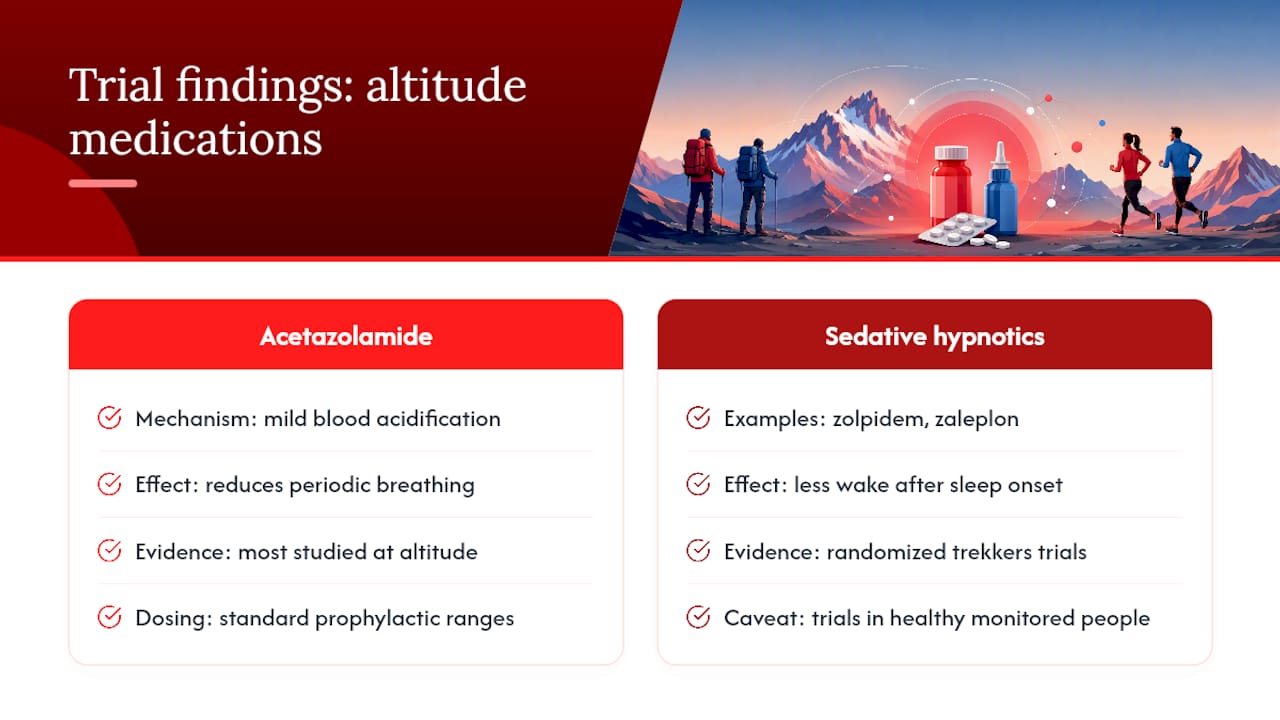
Acetazolamide is the most studied altitude medication for sleep. It works by acidifying the blood slightly, which stimulates ventilatory drive and reduces the overshoot-undershoot cycle behind periodic breathing. Typical prophylactic dosing runs in the range providers commonly prescribe for altitude illness prevention, though the exact dose and timing should come from a clinician who knows your health history and itinerary.
Sedative hypnotics are trickier. Randomized trials of zolpidem and zaleplon in trekkers at altitude found both drugs reduced wake-after-sleep-onset and modestly improved sleep efficiency, without measurable daytime impairment in the study populations. That’s a genuinely useful finding, but it comes with a real caveat: these were monitored trials in otherwise healthy participants, not a blanket endorsement for routine use. Sedatives suppress the same ventilatory drive that periodic breathing depends on, and using one without medical guidance at altitude carries risk, especially for anyone with symptoms of acute mountain sickness.
Supplemental oxygen: the most direct fix
Low-flow supplemental oxygen during sleep is highly effective at suppressing the periodic breathing cycle at its source, since it addresses the oxygen deficit directly rather than working around it. Options range from portable oxygen concentrators and tanks used by climbers on extended expeditions to short-term canned oxygen used as a nightly adjunct for travelers and athletes who don’t need continuous medical-grade support. Revo2’s guide on supplemental oxygen at high altitude walks through how reduced periodic breathing translates into more continuous sleep.
Statistic to remember: sleep efficiency at 4,559 meters fell from 93% to 69% on the first night before partial recovery by night three, a swing large enough to explain why so many travelers feel wrecked after their first night at elevation.
What to avoid
- Alcohol. The CDC explicitly warns against alcohol at altitude because it suppresses ventilatory drive and worsens breathing disruptions during sleep.
- Unprescribed sedatives or sleep aids taken without a clinician’s knowledge of your altitude plans.
- High-dose melatonin as a primary fix. It may help with jet lag around your trip, but it doesn’t address the underlying oxygen deficit driving periodic breathing.
Pro Tip: If you’re only dealing with mild breathlessness or fatigue, not chest pain, confusion, or severe headache, a short session of supplemental oxygen before bed can take the edge off enough to fall asleep faster. It’s not a substitute for the ascent-rate discipline that prevents the problem in the first place.
Where Canned Oxygen Fits Into an Altitude Sleep Routine
It’s built for accessibility: no prescription, no mask, no cumbersome tank setup, just a few clean breaths before you settle in for the night.
Realistic use cases include:
- A few minutes of oxygen before bed to ease breathlessness during the worst first-night adjustment period.
- Post-training recovery for athletes pushing hard workouts at elevation, where fatigue and brain fog can carry over into sleep quality.
- A portable backup for travelers who want quick relief from mild altitude fatigue without carrying medical equipment.
Canned oxygen is not a substitute for prescription medical oxygen or emergency care in cases of high-altitude pulmonary edema (HAPE) or high-altitude cerebral edema (HACE). Those conditions require immediate descent and medical attention, not a can of oxygen from a backpack. Revo2’s guide to using canned oxygen safely covers proper technique, and anyone considering acetazolamide or dealing with symptoms that persist past a few nights should loop in a clinician rather than self-treat.
Should You Actually Worry About a Rough Night at Altitude?
Most people feel noticeably worse the first night or two at elevation and still function fine the next day. That gap between subjective misery and actual performance surprises a lot of first-time high-altitude travelers, who assume a bad night means a wasted trip. It usually doesn’t. Acclimatization, combined with sensible ascent pacing and one or two of the tactics above, is enough for the overwhelming majority of recreational trips.
The exception is when symptoms escalate rather than plateau. Progressive breathlessness at rest, a persistent cough, pink or frothy sputum, a severe headache that doesn’t respond to rest and hydration, confusion, or loss of coordination are not “bad sleep.” They’re warning signs of HAPE or HACE, and they call for descent and medical evaluation, not another night of trying to sleep it off.
If you’re training or traveling at elevation regularly, track how your sleep responds over your first few trips. The pattern usually gets more predictable, and often milder, the more your body logs time at altitude.
— Paul
Breathe Easier Tonight With Revo2
Altitude sleep problems come down to one thing your body can’t argue with: not enough oxygen per breath. Revo2 makes that deficit easier to manage without a prescription, a mask, or a bulky tank. Each can delivers 98% pure oxygen through a zero-leak mouthpiece, so you get a clean, full dose instead of losing half of it to the air around you.

Whether you’re chasing a personal best at a mountain race, recovering from a hard training block at elevation, or just trying to get through your first night at a ski town above 8,000 feet, Certain oxygen product lineups cover these situations with blends designed for energy and endurance, recovery and immune support, and focus and relaxation. None require a doctor’s visit or medical equipment, and all are designed to slot into routines involving gradual ascent, sleeping low, and use of supplemental oxygen when needed.
Browse the full REV/O2 product lineup and pick the blend that matches tonight’s need, whether that’s winding down before bed or bouncing back after a long day above 10,000 feet.
Sources
- Can High Altitude Influence Cytokines and Sleep?
- CDC Yellow Book: High-altitude travel and altitude illness
- Effect of Short-Term Acclimatization to High Altitude on Sleep and Nocturnal Breathing
FAQ
Is it normal to sleep badly at altitude?
Yes. Hypoxia-driven periodic breathing fragments sleep for a majority of people at elevation, especially on the first one to three nights. Sleep efficiency and oxygen saturation typically improve as your body acclimatizes over the following days.
Is it safe to sleep at 9,000 feet elevation?
For most healthy people, yes, though you should expect some sleep disruption in the 8,000 to 12,000 foot range. Following a conservative ascent pace and the guidance to avoid alcohol and sedatives at altitude reduces both the disruption and the risk of altitude illness.
Did Michael Phelps train in an altitude environment?
Elite athletes across many endurance and combat sports use altitude training and altitude tents to boost red blood cell production and endurance capacity, a well-documented practice in competitive swimming and track. Specific claims about individual athletes vary by source, so treat any single anecdote with caution rather than as confirmed training history.
What is the healthiest elevation to live at?
There’s no single healthiest elevation for everyone. Moderate elevations below roughly 6,000 to 8,000 feet tend to cause minimal sleep or breathing disruption for most people, while populations who live permanently above 12,000 feet show long-term physiological adaptations that lowlanders don’t develop from short visits.
Does Revo2’s canned oxygen help with altitude sleep problems?
It can help with mild, short-term symptoms like breathlessness or fatigue before bed, since it delivers 98% pure oxygen through a zero-leak mouthpiece with no prescription needed. It’s not a substitute for prescription medical oxygen or emergency care for HAPE or HACE, and current prices for each product line are listed on the Revo2 site.